-
Why I can’t give up on the South
March Slave by Pyotr Tchaikovsky, Leonard Bernstein conducting the New York Philharmonic Orchestra.
To say I don’t like the direction much of Southern culture has taken would be an understatement. Though not all of us are so resistant to change. I know I changed a lot over my lifetime.
But there’s another reason I can’t give up on us: My dad.
My wife and I were chilling out, listening to music yesterday.
Out of nowhere, I suggested we listen to some classical music. I especially wanted to hear Tchaikovsky’s March Slav and Capricio Italien.
But it wasn’t out of nowhere. Sunday was Father’s Day.
If I ever wanted proof that the unconscious mind is always busy…
Dad has been gone for almost 30 years now, but I still miss the guy. Dad had failings. He was a man. But he gave me the parts of myself I’m most proud of.
When I discover a new band or a new type of music I always have this impulse: I have to see what Dad thinks of this. Then I remember I can’t. Dad was all about music. He played clarinet, directed high school band for many years.
He taught me to love music. Music was always playing in the house. He especially loved classical. I learned to love it myself. Also turned him onto the Alan Parsons Project late in life – he finally gave rock a chance.
When I read a book that makes my head spin, I wish I could talk to him about it. I can still see him lying on the couch with his nose in a book, or sitting at the kitchen table with a book and a bowl of popcorn.
He turned me onto science fiction by handing me a copy of The Star Beast by Robert Heinlein when I was 9 or 10. He turned the walls of our house into a library, full of history, literature and science. I could read anything I wanted.
Capriccio Italien by Pyotr Tchaikovsky, Berlin Philharmonic Conducted by Herbert von Karajan
He’s the reason it almost seems like I’m still in college. He talked to me like an adult, and could converse about nearly anything. I can’t stop reading the hard books and searching for Truth. That’s how he was.
He was a deacon in the Baptist Church. He directed the choir. He had four or five versions of the Bible, all highlighted and marked. He regularly consulted Isaac Asimov’s Guide to the Bible, even knowing that Asimov was an atheist.
If you couldn’t tell already he was not a typical Texan, Southerner or Baptist. But he had a curious mind and he grew, and changed. He came from poor and working class Southerners transplanted to West Texas. He served in the military, went to college and found a way earn a living from music in rural Texas.
Many of his best qualities came via education and the military, but some of them came from Southern culture. If Southern Culture managed to produce someone like my dad, there has to be something in it worth saving.
I guess this is one of those things that I’ve been hung up trying to express. Hope I did OK.
-
Do they make a laxative for the mind?
The Who – I Can’t Explain
It’s true that I’ve been dealing with joint and muscle pains that make it hard to write, but that’s not the real reason I haven’t posted much over the last few weeks.
Truth is, I’ve been constipated. Mentally constipated.
I’ve been trying to express some complicated thoughts that are just not coming together. As a matter of fact I have been writing. I just haven’t been finishing. I get two thirds of the way through a post and realize I’m stuck.
There is a general theme: What to keep, what to discard? I come from the country. I had a connection to the land once. I shared the religion and politics of the people in rural Texas and the broader South. Today, I very much do not.
I’m educated, progressive, “cultured.” I live in the city. I thought I had left it all behind. But something in me doesn’t let me forget. I think of old songs and get a lump in my throat. I dream of the hills, the wildlife, the cattle. The stories I was told. I remember Trivial Pursuit with my favorite preacher. I remember the old farmers and their wives’ casseroles.
How to explain to the people I identify with most today why I still care about those people? People whose politics threaten their very existence? Those who are being targeted by reactionary politics have every right to be angry.
I just can’t help thinking it would be a mistake to let it all go. That culture made me who I am. There has to be something of value. Some wisdom that can be extracted.
I’m still mildly constipated, but deep down I’m still working on the problem. Those thoughts want out. It’ll happen sooner or later.
-
Time for a new mattress?
Sorry for the lack of content lately. I slept wrong the other night and got my shoulder all jacked up. Got one of those deep tissue massages where the lady walks on you and beats the crap out of you. Straightened me right out. Once the bruises healed.
Gotta get serious with the yoga if I want to keep it that way.
BTW, just tried a trick I read about for killing a fly with your bare hands, and it worked! Flies have to jump before they can fly. If you hold your hands a little way above them and clap, they’ll jump right in the middle and it’s RIP fly. I don’t know whether I won or lost…
-
Plot against Dream Jesus – first Active Imagination experiment
I tried Carl Jung’s active imagination technique and it kinda worked. The fact that I was just returning to bed after an old man bathroom break probably helped.
The visions that led to Jung’s Red Book (aka Liber Novus) and ultimately informed most of his psychological theories were produced using this method, so I thought I’d give it a try.
I read that while doing active imagination, you can talk to the characters you imagine and they will reply. They did. It was brief but impactful.
Of course it’s still you – it’s imagination – but you can still learn something. It gives you a bit of access to the unconscious mind, which can in some ways be wiser than your ego, the part you think with.
It’s just that it doesn’t talk in words. It communicates through images and symbols, though it can take years to understand what they mean. Sometimes it’s good to ask your unconscious for answers.
Sometimes it solves puzzles before your thinking mind does. You just don’t always have enough pieces of the puzzle to understand what it’s saying right away.
I decided to use Jung’s technique on a nightmare that had been bothering me since my early 20s, back when I was still trying to be a Christian, though I was beginning think I might not be a Baptist. I think I just figured it out.
The Nightmare: Being a demon against my will
The nightmare involved a plot to assassinate Jesus. Race also played a minor role, but I wanted to understand it. It was disturbing, but the bad dreams are usually the interesting ones.
The decades-old nightmare I chose to investigate really ate at me. I hated even thinking about it. I decided that made it a good target for Active Imagination. One of those subjects I was avoiding.
As I said in the last post, this post involves religion and race. I promise not in a mean way, though if you’re religious you may quibble. I go my own way when it comes to spirituality.
In my nightmare, I was one of the unclean spirits mentioned in Mark Chapter 5. If you went to church, you probably remember that one – it’s the “My name is Legion” story where Jesus unclean spirits out of a troubled man.
The spirits were on their way to assassinate Jesus. The man we possessed ran through tunnels and culverts, looking for Jesus as I yelled “Stop! Stop! Stop!”
I was desperate not to take part. I kept yelling, “Noooo! Noooo! Let me out of this! I love Jesus. I would never do that!”
But there was no way to stop it.
I exited a tunnel and Jesus was sitting on a log in a dry creek bed, his back turned to us. Suddenly he turned and I knew he saw me, not just any “unclean spirit,” but me.
His sad look told me he was very disappointed in me. That was more than I could take and I woke, covered in sweat. My uncle said I cried out in my sleep. It was a fear I’d picked up in church, that I might one day become irredeemably bad.
The nightmare nagged at me for decades, more than a decade as a self-proclaimed Christian. What the hell was that dream trying to tell me?
I thought I’d figured the dream out years ago, though I knew nothing about Jung at the time.
Two themes jumped out right away: The first was betrayal. I feared I was betraying Jesus, and yet I felt betrayed because he never acknowledged I didn’t have free will.
The second theme was doubt. Questioning my deeply held beliefs was frightening at times, ashamed. I’d been warned about “falling from Grace,” something I’d vowed never to do. But my doubts refused to go away, hard as I tried to push them away.
Those two themes alone explained why I would have a nightmare like that. I was going through a transition. But I still felt like I was missing something.
I decided Jung’s Active Imagination might help me find the missing pieces. I was curious as to why it kept popping into my head long after it had quit upsetting me. I’m not that person anymore. I decided to ask my dream characters some questions.
I spoke the man the “Legion” of spirits had inhabited. “Did you find it unfair when Jesus judged you?”
“He was looking at you,” the man said. As I had suspected. The dream was about me and me alone.
It also bothered me that the man in my dream was black and that he, like me, was forced to do something bad against his will, just like me. (We didn’t actually do it.)
I asked him why race had been part of my dream. “I represent unfair treatment,” he said.
That made sense.
I asked Dream Jesus why he had judged me. “You were friends with sinners and tax collectors. You accepted the thief on the cross. You knew I didn’t mean you harm.”
“I was never in your dream,” he said. “I was part of your unconscious. You were judging yourself.”
I think that solved it. There were two main themes other than betrayal and doubt. These were judgment and unfairness. Two characteristics of the faith I grew up in that always bothered me and part of why I had to change my beliefs.
-
Phoebe Killdear, the right artist at the right time
Phoebe Killdear and the Short Straws – Fade Out Line. This is my favorite version so far…
I’ve been obsessed by Phoebe Killdear for days. I didn’t know they made rock ‘n’ roll chicks like her any more. Powerful, badass. She puts me in mind of singers like Patti Smith, Danielle Dax, even Diamanda Galas, though she’s way more accessible than any of those.
Phoebe Killdear and the Short Straws – Highway Birds (live in Paris). Very psychedelic version. They would have fit in very well at Psych Fest in Austin.
Innerquake from Phoebe Killdear and the Short Straws has been in constant rotation. That album has totally hooked me. It seems “Fade Out Line” was an international hit 12 years ago and I somehow missed it. Anyway it was new to me. When you get to be my age, 12 years is still recent history. The whole album is a banger.
I don’t know if she’s still working with the Short Straws, but I really enjoy watching their mesmerizing live performances. “Fade Out Line” really resonates. It describes a feeling I think most of us have these days.
Phoebe Killdear and the Shift – Dream B
The Piano’s Playing the Devil’s Tune fromfeatures Maria Medeiros (Bruce Willis’ wife in Pulp Fiction, is what I would call esoteric music. Right up my alley. Spoken word poetry, unsettling and hallucinatory.
More recently she’s been working with Melanie Pain a project called Kill the Pain. So far I’m digging the self-titled album, which is very catchy and a lot more upbeat than the other Killdear works I mentioned.
Kill the Pain – Zig Zag. This one reminds me a lot of Talking Heads. Styles on the rest of the album are pretty all over the place.
-
My evolution evolution
Devo – Jocko Homo. I love that line: “God made man, but the monkeys applied the glue.”
As a young man I accepted evolution AND held onto creationism. it was contradictory, but it worked – until my third year of college.
I grew up in the creationist-friendly Southern Baptist Church, but I loved science. Evolution was a common theme in the science fiction I read, but I could entertain a premise without believing it.
The Cinematic Orchestra – Evolution
I was very good at compartmentalizing. When you’re a Baptist you have to be. I also had common sense. I knew the world wasn’t 8,000 years old or created in six days. I knew there was no way the Noah’s Ark story could be literally true.
But I found loopholes. Maybe creationism was kind of true. A day for God might last a million years, who knew what six days meant to Him. Perhaps Adam and Eve were hairy, but human. My uncle was pretty hairy. Mostly I didn’t worry about it. I was too busy being a young man.
Then I took a college course that changed everything. It was called Human Geography and it was fascinating. I love learning about other lands and cultures. National Geographic helped raise me. I had no idea the course would also shake me to my foundations.
I learned about the Rift Valley of Africa, where the creatures that became us almost certainly originated. I learned about the extremely numerous fossils of pre-human cousins.
Fundamentalist conspiracy theories about “the missing Taung Baby exhibit” weren’t going to cut it. There were a LOT of fossils and they added up.
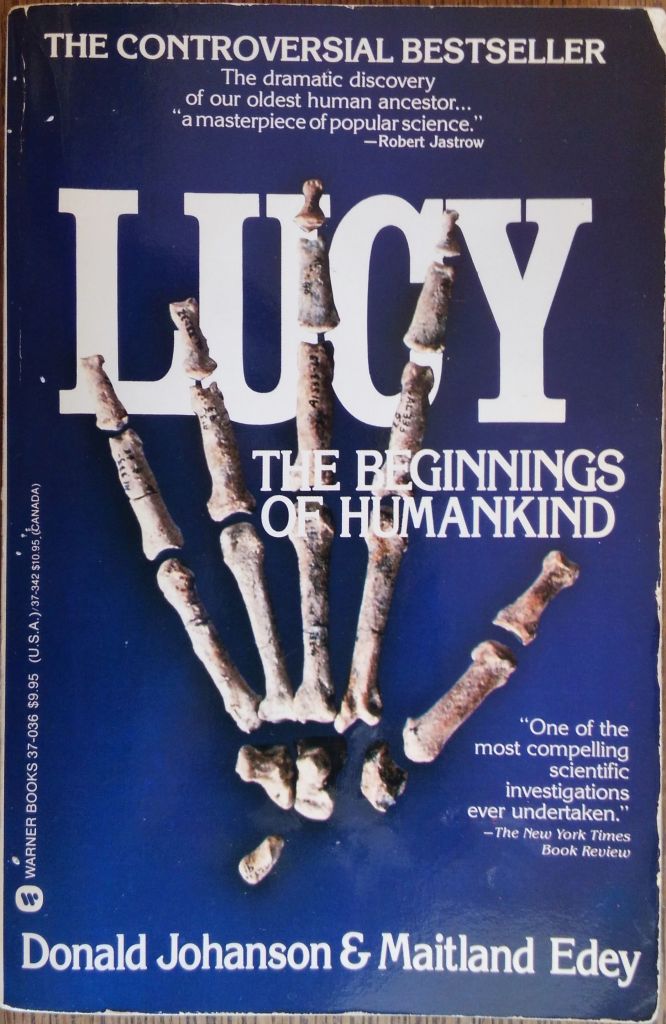
Studying Lucy by Donald Johanson and Maitland A. Edey sealed it. Lucy tells how Australopithecus afarensis was found (named Lucy after the Beatles song, “Lucy in the Sky with Diamonds”).
Her skeleton was so complete, there was no denying. She wasn’t human, but she walked on two legs. Obvious relative.
We learned about the other races of human that no longer existed. It wasn’t just us and the Neanderthal anymore.
There was Homo habilis, which made tools, though not with much finesse. There was Homo erectus, much better toolmakers who migrated into Europe and Asia. This was in the late ’80s. I know other species of human have been discovered since.
What I learned shook me up, but it also excited me. The science fiction fan in me wished for a time machine, so I could get a look at some of these creatures.
I wanted to see the waterfall at the Strait of Gibraltar, filling up the Mediterranean basin after a previous Ice Age (It may have been closer to a flood as it turns out). I wanted to see Australopithecus robustus, which I imagined as an upright silverback gorilla that could really take a punch to the jaw. My imagination was on fire.
We learned about Johanson’s argument with fellow paleontologist Richard Leaky over the age of a layer in the rock, which in turn impacted the age of some important fossils. It was striking, because they were quibbling over millions of years, not thousands.
I enjoyed the hell out that class, but it got under my skin. It nagged at me. My version of Baptist doctrine had been a given, part of reality. Suddenly the ground was no longer quite solid.
Budos Band – Origin of Man
How much of what I thought I knew was actually true? I tried to talk about it with my friends at the Baptist Student Union, but they weren’t interested.
“You should read some creation science” didn’t really feel like an answer. My compromise couldn’t last. I wasn’t really interested in what preachers had to say since I’d already been burned over the stupid Rapture thing.
Over time I came to terms with evolution. A lot of things made sense that didn’t before. No point trying to deny it. There was still plenty of mystery in the world.
I didn’t become an atheist. That came later (and I’ve modified that stance). But I had to change. I couldn ‘t call myself a fundamentalist anymore. If I was to remain a Christian, I would have to at least take parts of the Bible with a grain of salt.
I figured it contained a lot of truth, but in a book that old, a lot had to be lost in translation. I still value the Bible, btw, just differently. What makes it important isn’t literal truth, but the wisdom it contains.
-
Eye-beams are kind of a thing

I can’t read Latin, but I’m pretty sure the top panel says, “Holy shit it’s a dragon!” (Correction: I was just informed by a Spanish speaker who should know, that the top panel says, “Sic quasi membranæ volitant similæra per auras quaque palet quocunque licet caniunda feruntur” which translates to: “(they are) like flying ethereal particles, which are allowed to float piercing through the air.”
The Ancients used to believe our eyes worked by projecting rays of energy outward (extromission). Now we know the light must come to us. Still I think they were onto something.
Consciousness is a projection we see on the inside. When you look at the world you put your stamp on it. Something non-material – your mind – projects itself onto what you see.
It decides what you notice and what you don’t, which patterns are meaningful and which ones are not. You have to rely on your mind’s interpretation. otherwise reality would be nothing but noise.
You never actually see, hear or touch reality. You perceive it. How you perceive it determines how you interact with it. and that in turn does affect the material world.
They are not beams of light that you can detect or measure, but something is leaving your body and returning. not literally but metaphorically.
“Spiritual but not religious” used to sound like such an oxymoron to me. But It makes sense now. You can be an atheist and be spiritual.
No one knows what human consciousness is. It has a real impact on the world. You can’t touch it, measure it or examine it through a microscope. But you know it exists. You explore it in your dreams. It has depth and a kind of architecture you can study.
I don’t know what to call that if not spiritual.
-
Ants vs. ant lions – what comes around goes around
My fifth grade teacher wanted to teach us about doodle bugs so she made a terrarium with a doodle bug a stick and some ants.
The doodle bug ate the ants. Then it hatched out and grew wings and climbed up the stick. Then the ants climbed up the stick and ate the doodle bug fly.
Best science lesson ever. The cycle of life…
Doodle bugs are what we called ant lions BTW. An ant lion is the only insect whose adult form is named for its larval stage. I read that somewhere.

Some doodle bug traps I found in the Texas Hill Country. I don’t know if one of them managed to eat that millipede or not.
I grew up in the country and one thing you learned as a kid was how to catch a doodle bug. Just get under them and let the sand run through your fingers and there it’ll be, scooting around in your hand in a circle. It kinda tickled.
There wasn’t much you could do next other than let them go, so they could make another trap. We just wanted to know what they looked like.
I could tell doodlebugs inspired the Sarlacc in Return of the Jedi. Which is why I got so annoyed when George Lucas added CGI tentacles in the subsequent release. Doodlebugs do just fine without tentacles.
Now there are videos explaining the anatomy and life cycle of the tentacled version which seems like the movie review version of a bacronym. You know, like the USA PATRIOT Act (“Uniting and Strengthening America by Providing Appropriate Tools Required to Intercept and Obstruct Terrorism”).
-
Subscribe
Subscribed
Have a WordPress.com account? Log in now.


You must be logged in to post a comment.