I’ve been on a blogging hiatus, writing things in notebooks that I may or may not share. Still not ready to post on the reg, but I felt moved to share this. Seems like the time.
Passed a few fireworks stand and really wanted to buy some, but I don’t know anyone who wants to have a good firecracker fight and tbh I’m too old. So another fireworks season will pass me by.
And I got to wondering how much I care about American Independence Day anymore, now that democracy may be on the ropes.
I wondered if this might be the last Fourth of July I really care about, or if maybe that happened the day Dad died, July 4, 1997.
I’m of two minds I guess…
Which reminds me of a dream I had in October:
I was getting on a bus with some friends.
There was a lot of anger on the bus, because Superman had turned evil. It was all over the news.
The driver wanted to throw us off, because Superman was with us. Sort of.
I apologized to the driver and said “Don’t worry. There’s no way Hollywood is going to let Superman stay evil. There’s too much money in Superman being the good guy.” Superman was represented by an Igloo ice chest that we stowed near the front of the bus.
I said Superman had temporarily been changed into a “sorp.” (I bet that took a LOT of kryptonite.)
I haven’t managed to make a backronym for SORP, but in the dream it meant superposition. Good and evil at the same time. No way to know which until you opened the box. Schrodinger’s Superman.
Superman – in my dream, and in the collective unconscious – symbolizes the USA.
Hollywood meant Hollywood, but not just Hollywood. American culture at large. We live in an empire and we want to be the good guys.
Unfortunately those two conditions might be mutually exclusive. For me, for the time being, I think Superman will remain a Sorp.
I had a feeling this was going to be a difficult Easter for me. I’ve been pursuing a kind of metamodern spiritualism, part of which involves coming to terms with Christianity. I left that religion like a house on fire. It really did a number on my head.
But a few years trying to be an edgy Reddit atheist wore thin pretty quickly. Defining myself by what I’m not, repeating the reasons why, over and over. Expecting people to accept a position that life is meaningless and we should just be brave about it started to feel asinine.
After a while, the anger goes away (mostly) and you learn to forgive the religion you grew up with and start remembering the good things you got from it. All those extra aunts and uncles, a taste for the transcendent.
I’ll even give my steel man version of Christianity: It produced my dad and my grandfather, my father a Baptist deacon, my grandfather a Methodist elder. They were wise. That’s the main thing I ask of a religion, can it produce wise men? It doesn’t always, but it can.
I’ve had that very same revelation about Rastafarianism. I can’t buy the theology, but I cannot deny Bob Marley, or the Nyabinghi mystic in the movie Wah Do Dem – excellent little indie movie set in Jamaica. Norah Jones is in it, briefly. (Mystic scene starts at 58:30. Full movie on YouTube here. I think it might also be on FreeVee).
So yeah, my war against Christianity is long over. I’m sad so many good people feel they have to leave, for reasons similar to mine. But I’m not at war with it. I hope it becomes something that won’t require you to reject science, or embrace extreme positions. Something like it should exist. It has good bones.
I really admire the work some of the metamodern thinkers who have tried to find a bridge to Christianity. But I don’t think I can follow. Some things just may not be compatible. I see philosophers try, I see forward-thinking, open-minded Christian ministers try.
And often I see Christians who just can’t seem to go there, giving those answers that just don’t satisfy, and suddenly I’m 14 again, trying to reconcile a religious conundrum and getting answers that amounted to double-talk.
So I was in a mood this week.
Then I ran into the Easter jokes and videos of the type I used to watch, atheists dunking on Christians, not convincing anyone, arguments in the comments. With Israel and Palestine on my mind all the while, I just was not in the mood for a religious holiday.
I tried to be a good sport. After all, I go to a church where you can be an atheist if you want, or a non-theist neo-Platonist Daoism-curious whatever the hell I am at the moment.
I mean it’s Easter. How are you not going to have a story about the Resurrection? We have Christians too. We had an Ostara sermon for the neo-pagans last Sunday.
Didn’t even make it to the sermon. It was the children’s story that got me, the story about Jesus and the tomb, animated in the style of the Veggie Tales, so very cute. And I got so angry I had to pretend I was having a migraine (didn’t feel like much of a stretch) and leave early.
Not sure why I got so mad. I’m still figuring it out. Something to do with the ethics indoctrination maybe. Religions have to do it if they’re going to survive. I’m not one of those guys who says they shouldn’t. But maybe there are fair and unfair ways to go about it?
Is it fair to use cartoons to indoctrinate children? Cereal companies aren’t allowed to anymore. Is it fair to preach hellfire and brimstone at kids who’ve been thinking with their hormones all week at summer camp?
And what about those Hell Houses or whatever they’re called, those things I had to cover with a smile for the local newspaper, the ones churches put on for Halloween instead of haunted houses? Where the kid doesn’t listen to their Christian friend and winds up in hell? And it’s supposed to be scary-good fun and cute because the kids are actors. Is that fair?
I honestly don’t know and I’m tired of thinking about it right now. I just feel like Easter fell on a bad day for me this year. If they could pick a day on the calendar and not make me worry about the phases of the moon or whatever, maybe I’d be ready, but it seems to sneak up on me every year.
I was in the pool this morning and couldn’t resist staring at the light show on the wall and ceiling. It was beautiful, like fire, but not. I think I was the only one who noticed.
Got me thinking about the nature of things, and how so much of what we think of as real or solid, is just a pattern caused by ripples crashing into one another.
I wonder if you had enough computing power, could you examine the reflected light and discern how many people were in the pool and what they were doing?
As my exercise class got underway, the ripples of reflected light became more chaotic, as we thrashed around with our styrofoam “weights.” I thought how hard it is to detect a pattern when there are so many patterns going on all at once.
So much of what we take for granted makes sense when you think about it that way – society, culture, politics. Ripples intersecting – and the interference patterns they create.
Can you think of those 3D-looking shapes in the center as “objects” or are they just the effect of the concentric circles that make them up? I think culture is like one of those shapes, an interference pattern.
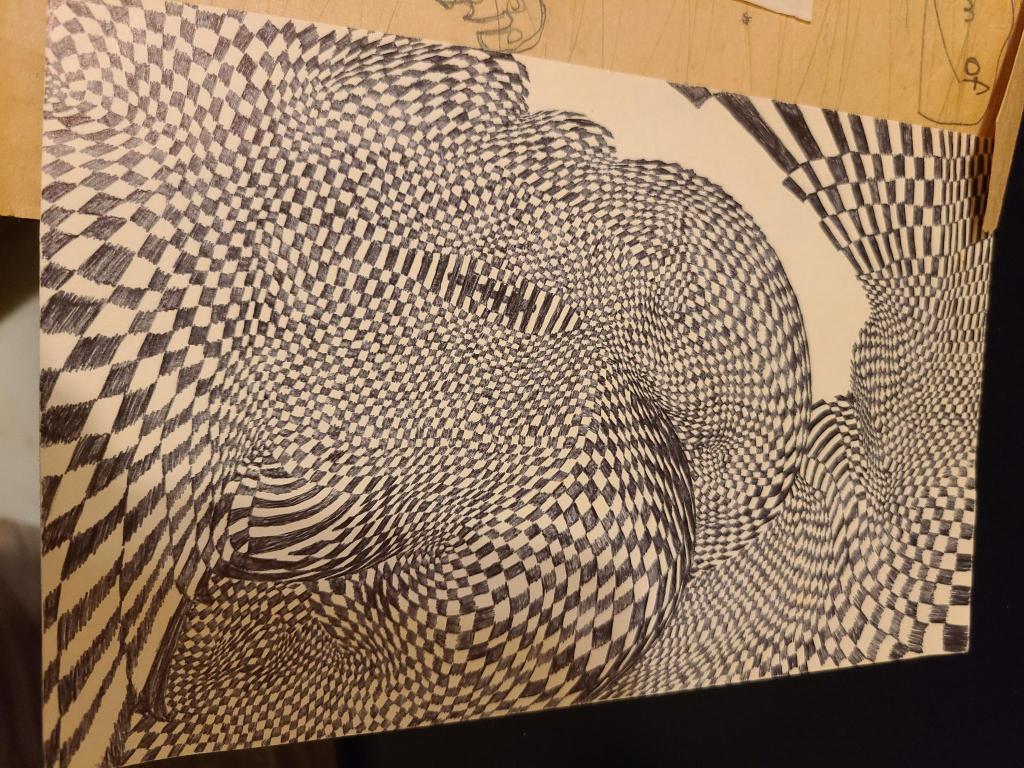
Interference patterns fascinate me. Back when I was a college art student, I got on an Op Art kick.
It was apparently fashionable in the 60s to decorate clothing and other items with distorted black and white checkerboard patterns. Most of it was eye-poppingly hard to look at, but the principle of it attracted me.
Especially the moire effect – the crazy patterns created when things like window screens and lace curtains intersect.
This was long before I had a computer, so all I had to work with were a compass, paper, pen and ink. My mother got annoyed over it. “We sent you to school to study art and you’re sitting around drawing circles?”
And distorted checkerboard art, which I decided was cooler.
Particle physics fascinates me. Muonium is a thing! Who knew? I at least try to follow news from the Large Hadron Collider. I know just enough to be dangerous, but I am familiar with the idea that a thing can be a wave or a particle depending on how you look at it. How strange.
It occurs to me lately that Western culture has maybe leaned a bit too hard on the particle side of things. Particles are like bricks. You can make things out of them. What would it feel like to see more of the world as waves?
Even a mountain is a kind of wave. Just an incredibly slow one. Usually. Icelanders can verify how fast and wavy “solid rock” can become. The crust of the earth floats on a sea of hot magma. You have to expect there are going to be ripples.
Cultures are like ripples, and ripples intersecting with other ripples. Sometimes, maybe most times, what you see as a defining pattern is an intersection of other patterns.
I think of a culture as concentric circles of influence. Art, music, movies, ideas about the world, how it works, how it should work, who’s good, who’s bad, what’s right and what’s wrong, what’s important, what isn’t.
There are dissonant ripples within. There are ripples from outside. The patterns get messy and chaotic like the lights on the wall when we began to splash around.
And sometimes they come together and form a new pattern, recognizable as an object. The ideal is to appreciate the beauty of that pattern in itself and not think you can or should pull the concentric circles apart.
I think Americans have been going through an identity crisis for quite a while now. What are we? People try to identify with one heritage or another, but it doesn’t quite capture it.
I’ve decided American culture is an interference pattern. We’re the shapes created when those circles intersect, not any of the constituent parts. I think that’s a better metaphor than melting pot. We’re not just this mushy stew. People abroad can tell we’re Americans.
They don’t recognize us as Europeans, Africans, Asians or what have you. We have an identity. It’s just not an easy to define identity. We’re like that light show on the wall at the pool. And I kinda like that.
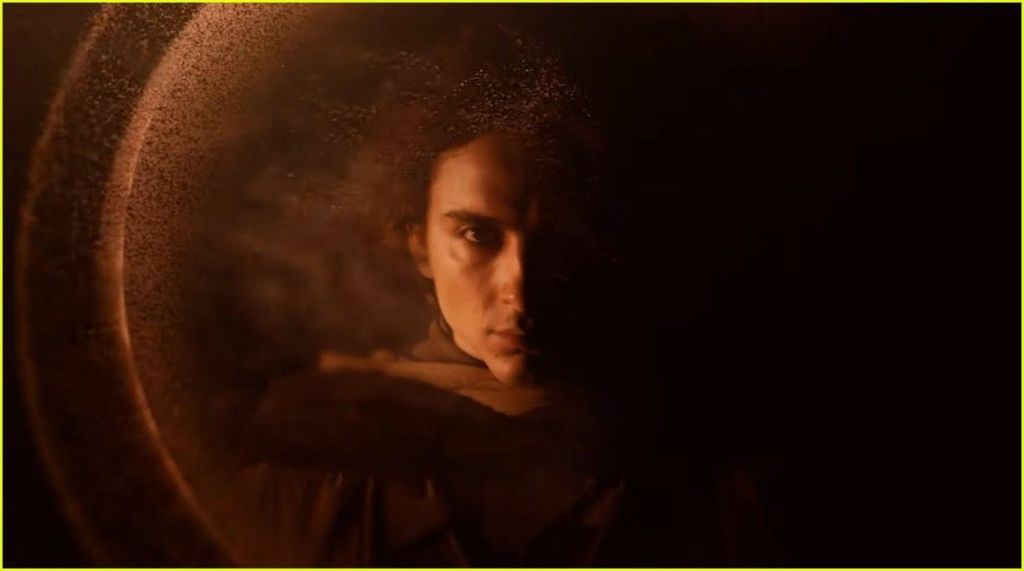
Just watched Dune 2 for the second time and it was a very different movie this time. But this time, I tried a little experiment. I decided to pretend like I believed in magic and see how it came across.
That’s where Dunes 1 & 2 succeeded magnificently. The fact that you can choose to do that or not and the movie still works is ingenious.
I think Villeneuve managed to do something Damien Walter has been calling for in his essays: bring the mythos back to the modern world. He gave us a story that kind of reenchanted the world.
The modern world has improved a lot of people’s lives, but at the same time taken away a lot of meaning. I don’t think people live well without meaning.
The fact that people are discussing and arguing about their interpretations of the Dune movies and books is a very good sign. I look forward to seeing more like it. Hopefully Dune Messiah will get made.
Where it falls short for me
I’m not sure how effective Villeneuve or even Frank Herbert himself have been at spreading these messages: 1) Beware of following charismatic leaders and 2) absolute power will rob you of your humanity.
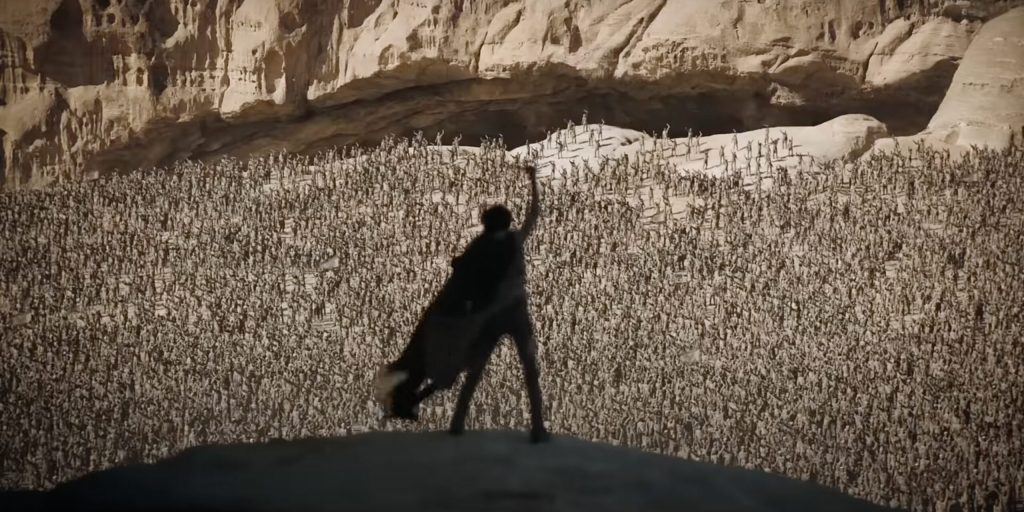
The problem with the first message is point of view. In Dune, the Fremen chose Luke Skywalker and ended up with Darth Vader. But the main character is not one of the Fremen.
Most people, particularly young men, are going to root for Paul Atreides all the way to the end, no matter how dark he gets.
Hollywood let the hero off the hook in the Star Wars trilogy. In this story, Luke was always going to choose the Dark Side.
To get the point across, I think we needed a main character who believed in Paul and became disillusioned. Something like a first person account of a Bedouin warrior who believed in T.E. Lawrence then saw his people freed from the Ottomans, only to wind up under the thumb of the British.
Villeneuve made Chani a stronger character than she was in the book in an attempt to get Herbert’s main point across. I felt it: Paul had betrayed his lover and the Fremen. What a shame.
But not everyone did (I saw someone say Villeneuve did it to please SJWs). The problem is Chani wasn’t the main character. People were still excited about Paul’s victory. Chani was just an acceptable casualty.
Watching Dune 2 as if I believed in magic made the power more… powerful. It felt like metaphysical cocaine, pouring out of the screen. Intoxicating.
Regarding point number 2, the darkness of power… well, that’s just a hard message for anyone to get across. I’ve never published a book or directed a movie so who am I to judge?
In particular, how are you going to convince young men who feel they have little or no power that absolute power wouldn’t be a bitchin’ great time?
It’s one of the worst addictions you can have, because you need it to survive. It’s like food. Not having it could kill you.
And yet I agree with Herbert’s point. Absolute power will take your humanity. The fact that major powers looking to one-up one another find it acceptable to threaten each other’s populations with nuclear destruction is rather monstrous, isn’t it?
Empires used to just sack each other’s cities and leave it at that.
Herbert makes his point by portraying power-hungry characters as ugly. The Baron Harkonnen is Jabba the Hut. Leto II turns into a worm.
Tolkien in The Lord of the Rings makes the same point: Don’t go for the One Ring or you’ll turn into a gigantic flaming eyeball.
The problem is, I think Herbert and Tolkien underestimated the number of guys who aren’t afraid of turning into a giant worm or a flaming eyeball.
Decided to give Altered Carbon another shot on Netflix. Season one. Not sure if I’ll try the second season.
It was better this time. Because I think it’s about an idea that’s on a lot of our minds lately: transhumanism. The idea that man and machine can and should become one and the same.
Is it ethical? Is it wise?
I remember liking both the book and the show, but I had a hard time suspending disbelief the first time around. The hard sci fi part of me wasn’t didn’t buying their method of space travel.
But this time around I realized I’d been looking at it all wrong. Whether it’s possible or not is irrelevant. These are the important questions: What is a human being and what is it worth? What, if anything, is the human soul? How are we different from animals or machines?
It has become common these days to think of the mind as software running on the hardware of the human body. Something that could be digitized and kept alive in an actual machine.
Is that possible and if so, what are the ethical implications? Especially if you think of the mind and the soul as essentially the same as I do?
I suspect that even if you could upload your mind into a machine or another body – something would be missing. Something important.
My outlook on that topic has changed over the years. Back when I was reading a lot of cyberpunk, I used to think I wanted that. Not anymore. Since it turns out we don’t understand consciousness, I don’t think they could get it all. And I don’t think that’s possible. I’m afraid I’d be giving myself a kind of lobotomy.
And if I’m wrong, if the soul CAN be copied, what does that imply? That it’s nothing special, only software. Would an exact copy of a person have rights ? The same rights as the original? Black Mirror has been all over that topic. The White Christmas episode… Shudder.
Assuming you could treat the human body as an expendable “sleeve,” what would that mean for society?
One obvious implication is massive disrespect for the human body.
And a massive loss of empathy. Especially from those who could afford multiple re-sleevings.
Which gets into the REAL point of the show as I see it: the immorality of immortality.
Notice the decadence of the Eternals. Notice the suffering in the world and how little they seem to care. Even the rich kids can’t grow up because there’s no place for them. No reason to be responsible.
Society is kind of that way as it is. The wealthy live longer than the rest of us. Better healthcare, better food, safer neighborhoods. Is that fair? And do we really want to make it eternal?
Saw Dune part 2 last night. I liked it and I think maybe I loved it. I still need to absorb what I saw, but it looked amazing. Definitely a spectacle, one that actually means something.
I’ve seen reviewers refer to it as the “Star Wars Killer.” I think that’s overstating the case, but I do hope it becomes a cultural moment for young people.
I was blown away when Star Wars came out. It was so different from what came before. Now, with so many Star Wars “products,” it doesn’t seem quite so special any more. We’re old, we had our turn.
There were a few changes from the original story, but I’d say they served Herbert’s vision.
Villeneuve conveyed a message that I didn’t even get when I read Dune the first time: Paul Atreides isn’t a hero. He’s an anti-hero.
The interaction between Paul and Chani made it very clear. Paul gained a tremendous amount of power, but lost so much that really mattered.
The fact that he didn’t have a choice – it was either win or die – doesn’t make it right. It makes it a tragedy.
The main point I take from that is, why the hell would you want to do all that shit if you DID have a choice? Only for power? How could it possibly be worth it?
I think it’s a message for guys raised on the mono-myth of the hero’s journey who think, “I would love to have that kind of power.” No you fucking wouldn’t.
My wife and I saw Dune at an IMAX theater. Really great seats.
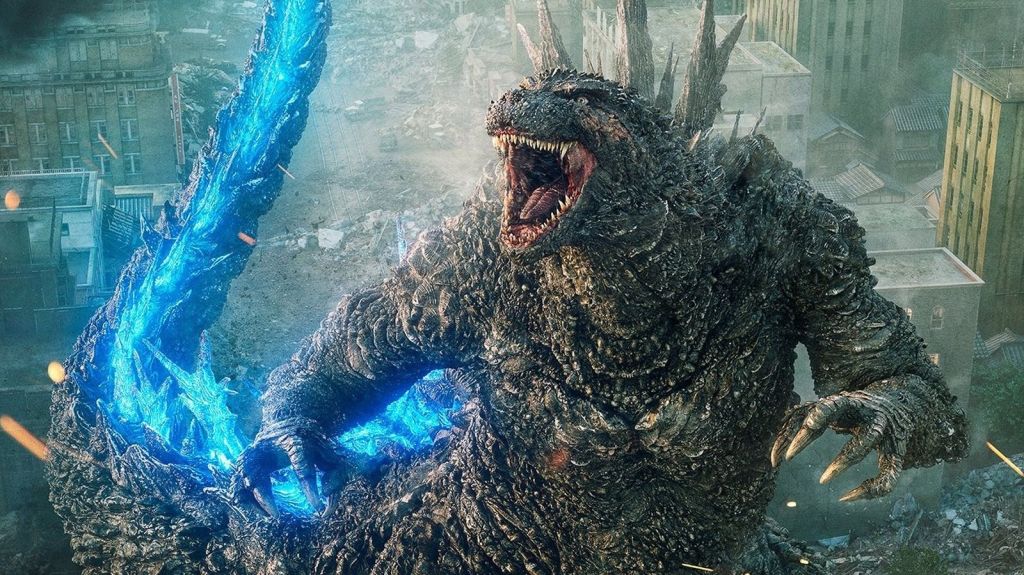
I loved Godzilla movies when I was a kid. I saw Godzilla vs. the Smog Monster(Godzilla vs. Hedora) in the theater. My brother was crazier about Japanese monster movies than I was. “Dear God, please don’t let a giant monster step on my house. Amen.”
Most of those movies were targeted at kids and were a lot of fun. As an adult, Godzilla movies have not impressed me. Until Godzilla Minus One. I didn’t expect to receive so much food for thought.
Setting the story in post-WWII Japan gave the movie an interesting dynamic. Especially since the main character was a failed kamikaze pilot. I cared about the characters and their predicament.
Instead of a disaster movie with a giant lizard, we got a man finding his purpose. Risking his life for his community, regular people dealing with an existential problem the “powers” were too preoccupied to take care of.
I’ve been told Godzilla represents the atomic bomb for Japan, but I think it goes deeper. I think it’s an expression of a hyperobject – something big and amorphous and impossible to ignore. Like global warming or the Cold War.
I’ve just begun reading Timothy Morton’s book about the concept, Hyperobjects: Philosophy and Ecology After the End of the World. I’ll get into it in this space once I’ve finished.
A while back I wrote that the movie Cloverfield is the best attempt I’ve seen to portray a distinctly American hyperobject – the imaginal monster that confronted us during 9-11.
I thought it might be interesting to compare the two hyperobjects based on some of my impressions from Godzilla Minus One. You could sum both imaginal monsters up as “powerful thing that might wipe us out,” but Godzilla has its own character.
Godzilla is Japan specific in a number of ways. For one thing, I feel like there’s an element of punishment. Shintoism has the concept of a Kami, a godlike entity that sends a tsunami when you’ve pissed it off.
Maybe throw in some resentment over how your cities got nuked thanks to the hubris of your leaders. getting nuked over the hubris of your leaders. And anxiety over being caught in the middle of an existential game of chicken.
I thought of that in the movie when the U.S. wasn’t available to help with the monster because it didn’t want to inflame the Russians. When monsters fight you’re bound to get trampled.
America’s “monster” a bit different in that there’s an element of Damocles’ sword. Having the power of a king means having a sword hanging overhead by a hair. America took on the role of a superpower and it still didn’t make us safe.
It isn’t just a king on a throne looking up nervously. It’s the whole country and in fact, the whole world.
Civilian populations are now bargaining chips. Because of us. Maybe it was called for at the time, but in any case, the bomb is one hell of a hot potato. And like the Japanese in Godzilla Minus One, we don’t really enjoy being put in this position.
There’s a sense of waiting for the other shoe to drop.
When I think of it, it’s all the same monster though it shows different faces to different cultures: the thing that shouldn’t exist, can’t be ignored and can’t be defeated.
“History shows again and again how nature points out the folly of man… Godzilla!” Blue Oyster Cult got it.
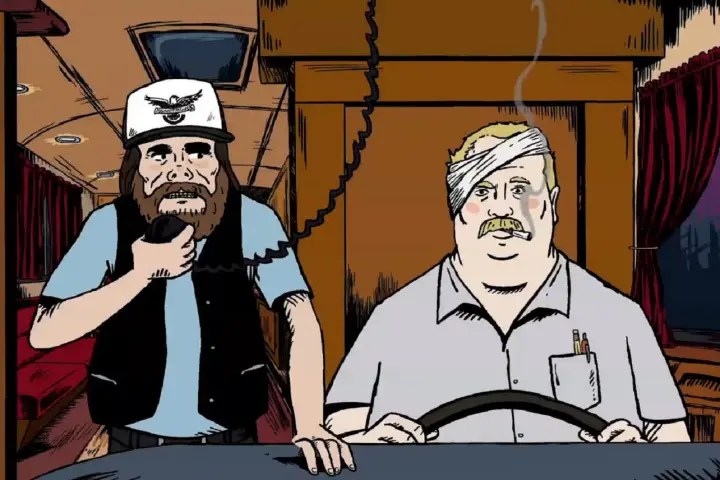
Outlaw country singer Johnny Paycheck, CB’ing truckers for a cocaine hookup. From Tales from the Tour Bus.
I’ve been amazed, learning all sorts of insane lore about various outlaw country artists.
I found out about this series of videos via Bill Burr’s podcast. I’m kinda like he is about it. How did nobody tell me about this? It’s hilarious.
Mike Judge, creator of Beavis and Butthead, King of the Hill and a whole lot of other great stuff, made a series called Tales From the Tour Bus. It’s apparently on Hulu which I’m not gonna get, but I’ve been watching these little shorts on YouTube.
The stories are insane. Of course I’d heard stories about guys like Johnny Cash and Jerry Lee Lewis being into drugs, but I had no idea how crazy the scene got.
You have to watch this one, where George Jones develops multiple personalities, one of which talks like Donald Duck and gets in arguments with his old man personality.
The above two videos are pretty damn crazy. Billy Joe Shaver shoots a guy through the cheek in a bar fight (he lives) and gets away with it in court.
When people call this stuff outlaw country, they mean OUTLAW country. These guys lived like gangsta rappers. It’s barely even a question of whether they were good or bad. They were a mess. Alcohol cocaine mental illness and guns.
And yet I love a lot of these songs. I probably would no matter what I learned. I’m not a huge country fan, but when I hear them I remember the words. They were part of my childhood.
Which got me thinking about the whole “can you separate the art from the artist?” question. I don’t think we have much choice especially once a work of art becomes part of the culture.
You can cancel Michael Jackson but it’s too late to cancel Thriller. Some things want to be in the culture and they’re going to be in it whether you like it or not.
I like how philosopher Timothy Morton refers to songs as entities in this exchange with Bjork. Entities… Not quite alive, but not exactly “things.” Almost spirits, because they can inspire.
Sometimes I feel like art wants to get into the world and it only needs a vessel. I don’t think it has a moral preference as long as it finds one.
It’s a polarizing movie but those tend to be the important ones.
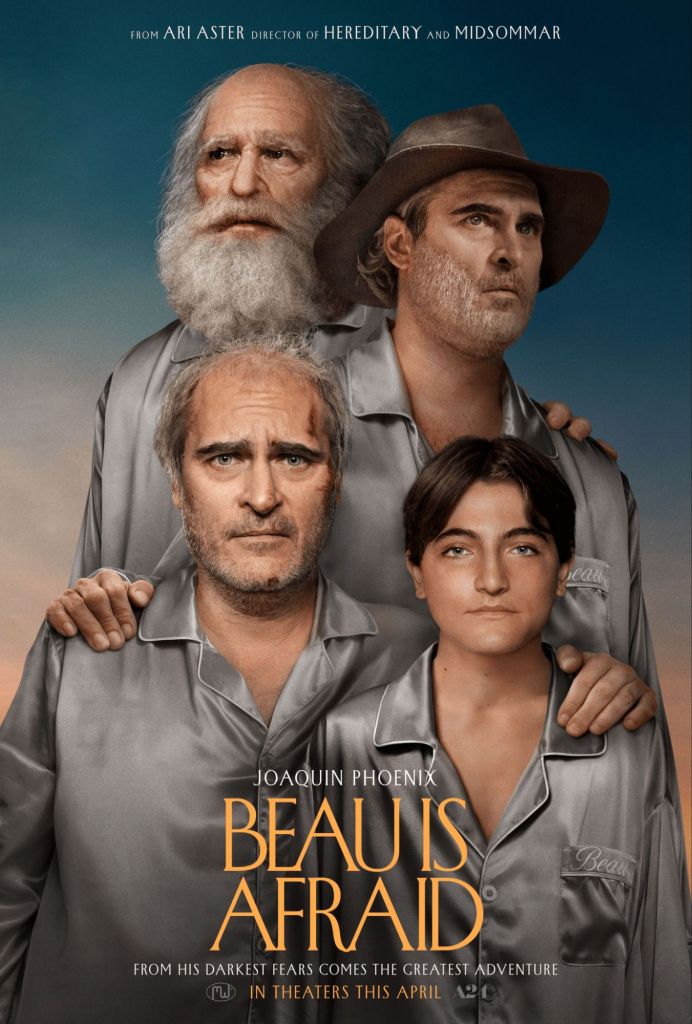
Beau is Afraid is the best movie out of the ones I’ve seen recently. Not necessarily the most enjoyable, but I couldn’t quit thinking about it, which is what makes it great. I’ve been obsessively watching director Ari Aster’s interviews and Q&A for days.
At this point I think he’s a genius on the level of Tarantino or Scorsese. It’s fascinating to see how normal and harmless he seems when his films are so disturbing.
Beau Is Afraid contains a lot of black humor as well as anxiety and sadness. I had to chuckle when he said he tends find the worst case scenario funny – reminded me of me. This is yet another movie about family trauma. Aster has been cagey about the nature of it, but judging by Beau Is Afraid and Hereditary (which traumatized me thoroughly), Aster must have had some traumatic family experiences of his own. People are driving themselves crazy trying to figure out what it all meant, treating it as a puz
zle to be solved when it’s not that kind of movie. The events and scenarios that frighten Beau are so over the top that you can’t tell what’s real. All you need is the theme: The horror of being a man child who isn’t allowed and isn’t able to grow up. It’s very Freudian. Think of it like a long nightmare that points to a deeper truth. The best way is to just let the dream logic wash over you. It reminded me of Pink Floyd’s The Wall. Similar theme of the narcissistic mother and the protagonist who attempts to become an authentic person and fails. Like Pink, Beau is unable to escape his traumas. There is a point where he tries to get over that hump and become his own person, but he fails. Doesn’t have enough juice.
It reminds me of the secret message in the Wall – at the very end Pink says “so this is…” and at the very beginning, “where we came in.” It’s a closed loop. You don’t get to know whether much of what Beau sees is literally true. So much of what happens is a projection of his fears onto the world. But we can draw some conclusions. His mother is evil or at least a malignant narcissist. That’s pretty clear. She might not have killed the housekeeper, but it seemed like something she would do. She might not have locked his twin in the attic, but it seemed like something she might have done. Telling him his father and grandfather died from having sex sounded like something she might have done. A very cruel way to keep him dependent. Everyone Beau connects with turns out to be on his mother’s payroll, so that there’s no one in the world that he can trust. His mother used his image to help build her business empire and apparently used him as a guinea pig for new drugs. Beau was only acceptable as a boy. She apparently had no use for men, even a grown-up son. Growing up means sex, and becoming a man and men are dangerous and unpredictable. It’s polarizing – not everyone is willing to watch a 3 hour movie where the would-be hero fails. But I think it needed to happen that way. Not every momma’s boy manages to escape. I think there’s also a larger theme about modern society: How to be a man in a world that has eliminated positive, traditional roles for men. Beau imagines himself as a farmer who protects his children, but that role is unavailable to him. If a boy child is made to believe that being a man is inherently bad, the only choices become be a bad man or remain a child forever. We need to normalize the concept of the good man.
For some reason I haven’t been in a writing mood. I’ve been in a movie watching mood – which has me back in a writing mood.
I’ve seen around eight movies since Christmas, some very good, some that at least made me think. Movies that make me think qualify as good even if they make me squirm.
I’ve been watching them differently. Or at least more consciously. I recently discovered Science Fiction YouTuber/Writer/Blogger Damien Walter, who talks about our movies having a mythos – the dreamlife of a culture.
He makes a pretty good argument. There are certain tropes, character types, surprise blockbuster and slow burn classics, that just have to tell us something about what we didn’t know we were thinking.
It’s going to take a while to write down those thoughts, so I’ll start with a list of the ones I feel motivated to write about: Godzilla Minus One, Beau Is Afraid, The Batman, Videodrome, The Colony, Anon.
I also saw The Boy and the Heron, at the theater, but I don’t have much to say about it at the moment. I’ll see it again sometime when I can pause it to the bathroom. Maybe I’ll have more to say then.
I know it’s heresy, but I haven’t really enjoyed Miyazaki’s movies, despite their reputation, except Howl’s Moving Castle. I still want to see Graveyard of the Fireflies if I can find it. I respect him, he just doesn’t speak to me.






You must be logged in to post a comment.