-
Hanging out in Lajitas, Texas
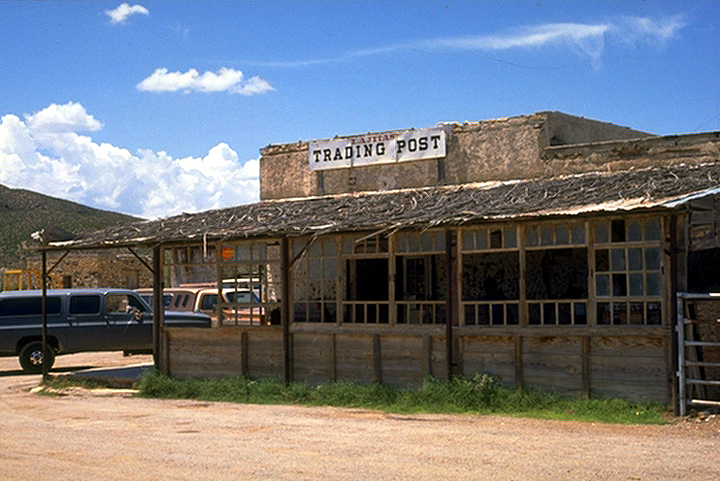
A while back I talked about my crazy night at the B29 bar Ojinaga’s red light district. That was definitely a memorable happening, but thinking of that got me nostalgic for our “home base,” that night. Lajitas, Texas.
Lajitas was a good place to camp back then, when you wanted to do West Texas stuff in the Big Bend area. But back then there weren’t that many people around. There were times when it felt like you had the whole desert to yourself.
I spent a number of weekends there, so the memories get jumbled together, but I miss that era that will never come again. Back in the ’80s when the border was (mostly) chill.
I remember hanging out in front of the old Trading Post at sunset with my uncle and his friends. There were bullet holes in the ouside wall, from Pancho Villa’s men, so they told us.
There was a pool table outside. Not very level, but you could play when the store was closed. I remember somebody put on the Willie Nelson version of “Pancho and Lefty,” which felt like a perfect way to close a day.
The area got to feel like a neighborhood after a while. Distances are relative. On the River Road was “Big Hill.” Just a yellow highway department sign really, but we made it a proper name.
You made sure to see “DOM,” letters scraped into a cliff face during the filming of Fandango, my favorite Kevin Costner movie.
There was a place on the side of the road where you could get out and look down at the Rio Grande, waaaaay down. You might go to La Kiva restaurant in Terlingua – still remember the bones of a “Penisaurus Erectus” embedded in the wall.
There was a village across the river in Mexico where you could pay a few bucks and a man with arms like tree trunks would row you across, where you could eat dinner at Garcia’s. In an adobe building with no running water. The food was delicious.
There was a blonde teenager they called Panchita who spent most of her time on the Mexican side in a little curio shop with no customers, listening to corridos and rancheras on the radio.
When I read Terrence Poppa’s Drug Lord, Life and Death of a Mexican Kingpin I wondered if Panchita might’ve been the daughter of an American lady mentioned in the book.
From what I was told, Lajitas and the village were basically connected. Tourists went to dinner in Mexico. Families from the village would cross the river sometimes just for something to do, like watch bootleg American movies before the copyright cops put a stop to it.
-
How I knew Trump would win
I’ve been wrestling with thoughts about what it means to be a progressive in MAGA country who saw it coming. The inner conflict, the feelings, the divided loyalty… You just can’t win.
Someone recently asked Beau of the Fifth Column if he expected Trump to win in 2016 . Beau, who lives in Florida and is as rural a Southerner as they come, said no, he “didn’t think it could happen here.”
I was a little surprised, because I did know. I didn’t know at first, but by November 2016 I knew.
One night I jolted awake thinking, “Oh my God, we’re gonna do it again aren’t we?” Horror, dread and grief washed over me.
“Why must we always sign up to be the bad guys of history?” I thought. “They use us for power and money and leave our culture in shambles? Why do we do it?”
Shame over the past masquerading as pride…
Interesting that I thought “we.” I spent most of my life trying not to be country, or Southern, or redneck – as if I wasn’t raising hell on the back roads as a young man, just like my snuff dippin’ beer drinking friends. Who exactly did I mean by we?
Like Beau, I came up in the country. Not as country as him, but close. Texas isn’t exactly “The South,” but we’re kissing cousins. We once waltzed into a meatgrinder together on behalf of The South.
I knew Trump was going to win. Maybe because I was a newspaper reporter who covered small towns for 20 years.
Or perhaps it was because I’d quit wanting talk to people I considered close as brothers over the hateful things they said on Facebook, and got the cold shoulder from others over my anti-Trump memes.
I had an inkling that we were headed in a bad direction during Obama’s presidency. I was hearing more racist jokes. Infowars turned up at a boring ass economic development meeting, shouting conspiracy theories. Tea Party members almost scuttled plans for a college campus our poverty-stricken town needed desperately.
I felt dread when Hillary got the Democratic nomination, Hillary who was synonymous with Coastal Liberal disdain in my part of the country, going way back to Rush Limbaugh. Rush used that very hook to fool me at first: “We’re nothing but ‘flyover country’ to them.”
I knew because Coastal Liberals who chose Hillary over Bernie didn’t know how badly the well was poisoned against her or didn’t think it mattered.
I knew when Hillary made the fatal mistake of uttering the words, “basket of deplorables.” And didn’t seem to know it was a mistake – or care.
I still voted for her in the general. She would’ve been so much better for America – and the South, whether they knew it or not. Almost anyone would’ve been better. But I knew my neighbors.
I knew because wealthy Coastal Liberals who have controlled the Democratic Party, as well as naive city liberals who supported them didn’t understand how they are perceived and don’t know how to talk to us without stepping on every cultural tripwire.
I knew because Trump might be a buffoon, but he’s a talented conman. I interviewed a local conman once and I learned how it works: Find out who your mark hates and you can take him for every penny.
Liberals were sure they were going to win because they had a better candidate – they did. Anyone would have been better. But future MAGA knew the Democratic Party didn’t care and Trump (who also couldn’t give a shit but pretended to care) got to them first.
-
Risky sincerity coming soon…
Couldn’t write a thing for a few days thanks to my shingles vaccine. The microchip doesn’t play well with the Covid version apparently 😉
But I felt well enough today to write another one of those drafts that sits in the app, 90 percent done waiting until it’s just right or chickening out. I don’t want to be seen as someone I’m not, but I have thoughts. So I write drafts…
I’ve seen some signs that more people are craving the real, the sincere. Maybe I can get in on that early and catch the wave.
Still it’s risky to be sincere on the Internet, especially when you’re between tribes like I am, trying to grow and stay out of boxes.
I have some sincerity lined up for tomorrow. Maybe folks will be charitable with me. I’m going to talk about being a progressive in a MAGA state, and why I saw it coming.
I don’t have any answers, but I know that we’re not going to get anywhere if we can’t talk. So tomorrow I talk.
The Internet feels like End Stage Tower of Babel these days. Even when you think you share a language, you don’t.
Maybe it won’t stay that way. Maybe people will take me as sincere and return the favor. Like I said, rays of hope.
Still I better give that draft another once-over in the morning.
-
Discovering Karnatak culture
Varaha Roopam from the soundtrack of Kantara.
I’m so overwhelmed, I don’t even know where to begin. I was going through YouTube, looking for interesting traditional music from around the world and discovered the arts and music of Karnataka, a state in the southwestern India.
Om Shakthi Jai Shakthi – Ravi Raj Karadi and team Beemsandra Tumkur. The video that first grabbed my attention. The costumed dancers are depicting the goddess Durga in her angered form, about to vanquish the evil lord Mahishāsura. This is part of the story of how the evil asuras Chunda and Munda were slain by the goddess Kali. (Thanks to a friend on Mastodon who filled me in.)
Some of it I loved right away. Some is so different from what I’m familiar with, I can’t tell yet. All of it fills me with awe. The variety of rituals, the complexity, the way everyone there seems to be involved.
I’ve never experienced anything like that kind of depth of culture. One thing in particular that blows me away is the theatrical art of Yakshagana. Through acting, singing, dancing and elaborate makeup, participants tell stories from history and religion.
Yakshagana – Bheeshma Vijaya 2
Vocal percussion tradition Konnakol is an art form I’m still trying to tune my ears to. One thing is for sure, this takes a TON of skill and training to pull off. Beyond impressed.
V Shivapriya & BR Somashekar Jois – Konnakol Duet
-
Maybe the King in Yellow is real?
I had forgotten, but this video jogged my memory. Interesting story collection that I might read again soon.
I first came across the name, The King in Yellow, in the Blue Oyster Cult song, “ETI,” just a brief reference: “The King in Yellow, the Queen in Red…” But I loved BOC and always wondered what all their symbolism referred to. Who was The King in Yellow?
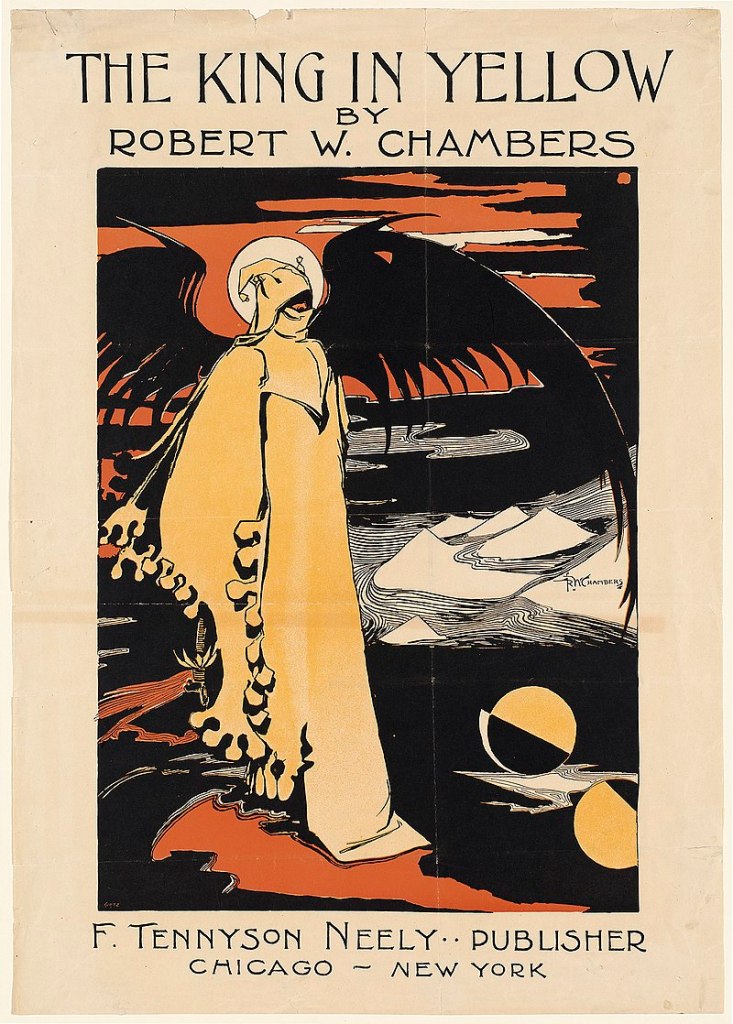
Sometime in the ’90s, I decided to find out. I read The King in Yellow, a short story collection by Robert Chambers that refers to a play of the same name that drives everyone mad who reads it. Like a mind virus.
I thought it was a pretty cool conceit. I wonder if it might have inspired Infinite Jest, David Foster Wallace’s novel about a video so addictive people rewatch over and over until they die.
When I opened The King in Yellow, I couldn’t help thinking, “what if?” Same delicious forbidden fruit feeling I got when I listened to heavy metal as a religious teenager. I didn’t think it was devil music, but it still felt like I was taking a risk.
Blue Oyster Cult – E.T.I.
I remember “Repairer of Reputations” in particular, where Hildred reads the play while recovering from a head injury and becomes convinced the spread of the play has prepared the American people to reestablish Lost Carcosa and make him king. Like something was manifesting into reality.
I’ve had that feeling before, like if you just knew how, you could pull some of that dream stuff out into the world and make it real. I think of it as “the dragon’s whisker.” I know you really can’t. But it FEELS like it.
The play in The King In Yellow used to just seem like an interesting device. No way reading a creative work is going to make you crazy and mistake fantasy for reality.
Then it occurred to me. The Internet does that all the time.
In one way, the Internet is exactly like Infinite Jest, so addictive you can’t stop looking at it, even as your life falls apart. But perhaps the King in Yellow is an emerging inhabitant of the Internet, trying to be born.
He lures you in with that first act, then breaks your mind in the second act, tells you how important you are, has you pining over imaginary empires and your place in them.
That was just stoner brain talking, but now I’m kinda spooking myself.
-
‘Big Surprise’ in Ojinaga’s red light district
Los Tigres Del Norte – El Zorro De Ojinaga (The Fox of Ojinaga). A corrido about the drug kingpin who ruled much of the trade of marijuana and cocaine between Mexico and the US before the advent of the cartels.
The barker in front of the club called out with heavy reverb, “El B29-nine nine nine… Beeg surprise tonight-night-night…”
There was a big surprise all right, but not the one he meant. This was in the ‘80s, while I was on break from college. My first and last visit to Boys Town.
My uncle and a couple of his friends had invited me to go whitewater rafting on the Rio Grande, back when it had water.
After a long drive through West Texas, we arrived at our campsite in Lajitas on a Friday afternoon. We had some time on our hands and decided to go out for dinner, so we headed to the international bridge in Presidio.
We figured we would eat dinner at the train station in OJ, then check out Boys Town.
OJ was our nickname for Ojinaga. Boys Town was what everybody called the red light district. OJ’s red light district wasn’t as famous as the one in Acuña, but it had an anything goes reputation.
Going to Mexico was easy in the 80s. No passport, no fussing about walls. My uncle didn’t want to take his truck across, so we caught a ride from a resident on his way home for the evening.
We tapped the side of his pickup and he signaled for us to hop in the back. Common courtesy back then. He drove us to the checkpoint. From there, we walked to the end of the bridge where we found a taxi waiting.
He drove us to the train station, and agreed to return in an hour and take us to Boys Town. We finished dinner early and thought, why not catch a ride from the taxi parked out front? A taxi is a taxi, right?
We struck up a friendship with Driver Two, who I’ll call Roberto. He didn’t speak English, but my uncle’s friend Mando translated. He had a lot to say about Boys Town and how the girls there all liked white meat.
After a surprisingly long ride, we arrived at a collection of bars and clubs. He dropped us off and agreed to come back in a couple of hours.
The first bar was quiet and nearly empty. We chatted with the lady at the bar, who had a really cool bracelet made from old Pesos.
About half a beer later, a man burst in the door and tapped Mando on the back, hard. Taxi driver Number One had found us and he was pissed! Behind him was a cop with some kind of assault rifle.
“You made me come all the way back to the train station and you weren’t there,” he said in Spanish. “You’re paying my fare!”
Mando relayed the message. No arguments from us. We didn’t even bother to count. We just grabbed whatever bills we had and put them in his hand till he went away.
Lesson learned. Wait for your taxi.
We weren’t ready when Roberto came to get us. Mexico partied late! The strip clubs weren’t even open. He said he’d find us on his next trip out.
We looked for a more happening bar and figured, why not see a strip show? We weren’t there for the brothels. The barker at B29 Cabaret got our attention. What was the big surprise?
It was dark inside. My uncle and his buddies found a table and ordered a round of Dos Equis for themselves and a bottle of Coke for me.
Then an inebriated man at another table motioned for me to come over. Why me and for what? I was nervous as hell, but I went.
All he did was stick out his hand and say, “Americano.” He apparently liked the look of me and wanted to shake hands with an American. That memory really stuck with me.
Several beers and Cokes later, Roberto turned up. We still weren’t ready. He’d made several runs to OJ and back, but we still hadn’t seen a show. They were trying to find out how much beer they could sell us.
We invited Roberto to sit at our table and bought him a beer. He settled in and had several. He’d picked up enough fares for the night and was there to party.
After a while he got up and hollered. “Bring out the girls!” he said in Spanish. “These gringos want to see a show!”
And was there ever a show. Three girls came out and danced on the stage, then came out on the floor, between the tables, including ours. I’m sure I was blushing.
I thought they were cute, but I didn’t enjoy it as much as expected. I could tell they didn’t want to be there. They wouldn’t look you in the eye.
Then Spanish classical music began playing and out came a tall woman in a fancy dress and headdress. She wore a lot of makeup and had long, false eyelashes.
She held up a fan and performed a classical dance, demure, but flirty.
Then the DJ put on something with a beat. She thrusted her pelvis and gave all the drunks the come-on. She lifted her dress and did something with her high-heeled shoe. I saw a lot of tongue.
Then ta da! She tore off her top, took off her wig and took a bow. She was a he. My uncle and his buddies’ mouths were hanging open.
They were older than me and had their beer goggles on. I’d been drinking Cokes all night. I thought he was a woman, but too old for me and wearing too much makeup.
I just thought, huh. I guess that was the “beeg surprise.”
There were no more girls, but the night was far from over. A conjunto band started up. Mexican men wearing oversized cowboy hats and buckles danced with their wives (or girlfriends more likely). Roberto got up and spoke to the band.
We were all exhausted except Roberto. He was into the music. “I’m waiting to hear my song, then we can go,” he said. I was about to fall asleep.
All of a sudden, “Crash!” A man threw a metal chair in the center of the room, cursed in Spanish and stomped out and nearly slammed the door off its hinges.
I thought “Oh shit! Which way is north? Am I gonna have to walk to the border? What if he comes back in with a gun and starts blasting?”
But apparently that was par for the course at the B29. The band played another song and folks went back to their cervezas.
“We can go now,” Roberto said with a grin. He and the band had given us the REAL surprise.
He filled us in on the way back to OJ. The federales has just killed the local druglord in a shootout. The man who threw the chair was the druglord’s brother.
Roberto recognized him and thought it would be great fun to request a corrido about the shootout. Roberto wasn’t afraid of much apparently.
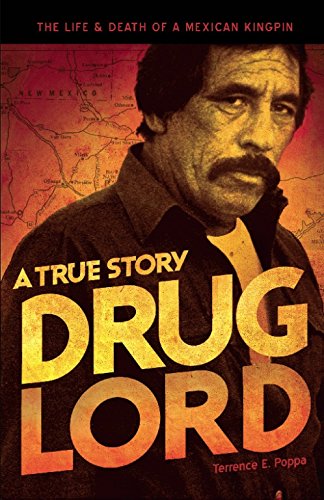
Incidentally, I read Druglord: Life and Death of a Mexican Kingpin, by Terrence Poppa in the ‘90s and learned a few things about that night. The druglord who got shot had to be Pablo Acosta, who turns up in the Netflix show Narcos Mexico.
I haven’t found anything about Pablo having a brother, so maybe the guy meant compadre or associate. I don’t know who the band was, but the song was almost certainly “El Zorro de Ojinaga,” made famous by Los Tigres Del Norte.
Not sure what the cab driver’s deal was or why the chair thrower was so pissed. The song makes Acosta a tragic hero as far as I can tell. I reckon he must have had enemies though. Maybe it was just a case of “too soon.”
-
Remembering the Cedar Choppers
Ken Roberts, author of The Cedar Choppers: Life on the Edge of Nothing, talks about his encounter with a pair of Cedar Chopper kids on Bull Creek, when he realized there were people in Austin with a totally different culture.
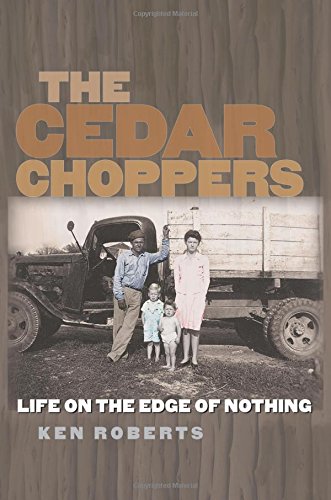
I grew up in the Texas Hill Country in the ’70s and I want to talk about the Cedar Choppers. I’ve been reading a really interesting book about their history, The Cedar Choppers: Life on the Edge of Nothing, by Ken Roberts.
I’ve already learned some interesting things. Like for instance, you’d think with that drawl and being in the South, that the Cedar Choppers would’ve been all in for the Confederacy during the Civil War.
In fact, they were just as divided as everyone else. Roberts writes about an outfit headed by Dick Preece (1833-1906) that refused to fight for the Confederacy. “For two years they used the hollows and caves of Bull Creek to wage guerilla warfare against the Confederate home guard, calling themselves the Mountain Eagles.”
Not something I expected.
Hallie Mae Preece singing ballads for John and Alan Lomax in 1937. She was part of an old Cedar Chopper family from the Bull Creek area outside of Austin.
I recognize most of the last names in the book. I wasn’t a Cedar Chopper, but in a way they were my people. They were part of the mix, always around. I had some as friends. Grandpa, who was a medic in WWII, used to go into the hills when they had emergencies.
They’re the people who cut the cedar posts that fenced the West. Same people as in Appalachia, but at the end of the migration. They got to the limestone hills of the Edwards Plateau and never wanted to leave.
Until the economy made them.
Alexa Dee Crooks sings Little Blossom, a song that made it to Central Texas through Appalachia, all the way from the British Isles. Read her description under the video. Interesting stuff.
They provided wood and charcoal that powered Austin, Texas as it modernized. They made some of the best whiskey during Prohibition. They got to hunt and fish and live next to clear running streams. The Ashe Juniper kept them afloat during the Great Depression when so many others were going broke.
Gene Landrum – No Beer In Here, Cedar Chopper blues recorded in Boerne, Texas, in 1978.
Now their former territory has been nearly wiped out by urbanization. I get sad every time I drive in the outskirts of Austin and see the exclusive neighborhoods on Lake Travis, pretending to be “Tuscan.”
The people who live there think they have everything, but the Cedar Choppers were richer if you ask me. Eventually that rocky, almost worthless farmland, became “scenic” and worth a fortune and the Cedar Choppers had to move to town. Everyone lost.
An unnamed storyteller relates the tale of a loudmouth who made the unwise decision to pull a knife on a cedar chopper.
A lot of the reason I miss the Cedar Choppers is the very thing some people hated about ’em: how they could and would beat the ever lovin’ shit out of you if you disrespected them. I respect their cussedness.
Because people in town did disrespect them, a lot. And it wasn’t right.
They had the fiercest honor culture you ever heard of. If you were in the know, you didn’t fuck with them. Great friends, terrible enemies.
We had legends about them.
There was the one about the Cedar Chopper driving in the outskirts of Austin with a load of posts who decided to stop and let his kids buy Cokes. When the kids came out and said the man refused to serve them, he went in with a chainsaw and sawed the counter in half and said, “Now sell my kids a Coke.”
How do you not respect that?
They’ve owned the term at this point, but when I was a kid, calling someone a Cedar Chopper would get you in a fight. A lot of townies looked down on them, but if you were smart, you minded your manners.
Granny used to equate forgetting to comb your hair with “going out looking like a Cedar Chopper.” I think that was projection. She grew up a whole lot like a Cedar Chopper on the headwaters of the Guadalupe, and didn’t get treated very well when her family moved to town.
I actually owe my life to one Cedar Chopper neighbor who my mom said looked like she could whip a bear with a stick.
She caught me and my friends trying to crawl into a “cave” in front of her house where the ground had collapsed over the new sewer line. She saw what we were doing and said, “Oh no you ain’t!” and closed up the hole with a pickaxe.
We were so pissed. “Why doesn’t she mind her own business?” But that would have been the end of me. She also annoyed me and my siblings by making us share our candy with her kids. Different ideas about property it seems like. In the hills, squabbles over candy were probably a matter of cousin vs. cousin.
I also remember her park ranger husband shared a watermelon with me once on their front doorstep. I was just some kid on the street. They were different than us, but good people.
-
Travelers and the ethics of sacrificing others
I’ve decided what I think makes the Netflix Show Travelers so interesting. It’s a time travel story, but really it’s a story about the ethics of human sacrifice.
The fact that the time travelers arrive in the 21st century by taking over other people’s minds, sets the tone right away.
They take the high road by (mostly) taking the minds of people who are about to die, but that’s a rather weak justification.
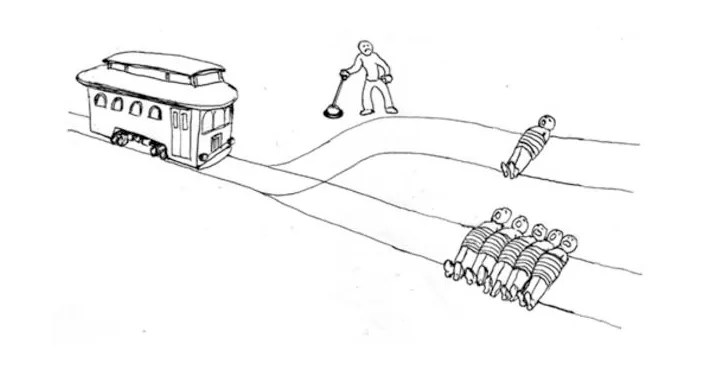
They area clearly trying to do the right thing, but they are still playing a hardcore game of Trolley Car Problem.
You know, the dilemma where one person is tied to one track, five people to another. You can throw a switch and kill one or do nothing and five will die. Which is the moral choice?
Travelers raises the stakes even higher. Which and how many individuals must be sacrificed in the past to save humanity in the future?
We make similar decisions in the real world. We can’t know the future, so there’s no way to justify the sacrifices of others that our society makes for supposedly greater cause. But we sure try don’t we?
The Director is in a better position than we are. It can know the future, sort of. But because it exists in multiple timelines, it can’t base its decisions on certainty, only probability. It’s very smart and it means well. But it makes mistakes, so do its operatives.
There’s no way to “win” the trolley problem. You have to make a bad choice. But you know the main characters are the good guys – because they’re the main characters.
Just like all of us. The stakes might not be as high as they are in Travelers, but everyone gets into damned if you do, damned if you don’t situations.
We also know when we didn’t really have to make that bad choice… But we know we’re the good guys – because we’re the main characters.
-
Musician Farya Faraji – evangelist for authentic folk culture
I have to talk about this guy: Farya Faraji. I really like his attitude.
He’s a singer, musician and a composer, but more than that, he’s an evangelist for culture. Persian music, Greek, Turkish, Balkan, Byzantine, lots more. They all get handled with skill and respect…
“My goal is to showcase musical traditions from all over the globe, regardless of culture, ethnicity and religion,” he says on his About page. “I want this channel to be like a musical world museum, a library of musical traditions from all over the world and all over time.”
I think he’s right. The world is hungry for this sort of thing. Real culture. Real roots. Everybody’s. Something that connects us to the parts of our culture the modern world threw away.
I like that he’s trying to give us a taste of the real thing, real culture and not the Hollywood corporatized version of culture. I approve. He’s already taught me a few things. I didn’t really understand just how Hollywood our concept of Greek music is.
I’ve always thought of Greece as Eastern, but not THAT Eastern. It has also caught me off guard, hearing Greek music that sounded Middle Eastern, but what he says makes sense. Cultures in close proximity to one another are going to have things in common. Greece is a lot closer to Persia than it is to England. What else would it sound like?
I hope his channel really takes off. I hope to see similar projects from other musicians. I’d say Peter Pringle is a good example, taking us WAY back, to the Mesopotamian cultures.
So many of us have forgotten how precious culture is. We’ve lost touch with the earth. We need to appreciate music that comes from the roots – our roots and everybody’s roots. Stop getting riled up over other generations’ wars and just enjoy the music.
I say this as an American Southerner who wishes he’d listened to his great uncle play the fiddle when he had the chance.
-
Subscribe
Subscribed
Have a WordPress.com account? Log in now.


You must be logged in to post a comment.