There’s a place in the eye where the nervous system meets the retina. That area can’t detect light. There’s a simple experiment you can do that will show you where it is.
What blows my mind is you have to try to see it. It’s not a black spot. It’s a blank spot. Same color as the background. Your mind fills it in with what it assumes must be there.
There are conditions that make it obvious. When I have a migraine (it’s been a while thank God), I can’t see what’s in the very middle. I had a migraine on press day once. Reading words on a screen was excruciating. I could only see the edges of whatever I looked at. Luckily I spent a little time in a dark office and it went away.
The old woman I met on a Greyhound bus once, was an even more extreme example. She said she couldn’t see the middle of anything. It sounded pretty disabling, but she seemed to get a kick out of it.
“I looked out the window at my little weenie dog yesterday and he was just a dog’s head attached to a tail,” she said. “Then he turned to look at me and he disappeared. Haw haw.”
I’ve been pondering what all that implies. First of all, it’s always possible you could miss little things, just because you literally can’t perceive them.
You don’t even have to get into how we can’t see infrared or ultraviolet. There are just… holes in our perception. Our brains hide them from us.
If a critter had been riding on that woman’s dog, she never would’ve seen it.
If you have reasonably good eyesight, it isn’t likely that anything you need to see will be hiding in your blind spot. But it could.
We can only see, hear, feel and taste what our bodies will allow. There will always be a layer between us and what’s truly there.
Decided to give Altered Carbon another shot on Netflix. Season one. Not sure if I’ll try the second season.
It was better this time. Because I think it’s about an idea that’s on a lot of our minds lately: transhumanism. The idea that man and machine can and should become one and the same.
Is it ethical? Is it wise?
I remember liking both the book and the show, but I had a hard time suspending disbelief the first time around. The hard sci fi part of me wasn’t didn’t buying their method of space travel.
But this time around I realized I’d been looking at it all wrong. Whether it’s possible or not is irrelevant. These are the important questions: What is a human being and what is it worth? What, if anything, is the human soul? How are we different from animals or machines?
It has become common these days to think of the mind as software running on the hardware of the human body. Something that could be digitized and kept alive in an actual machine.
Is that possible and if so, what are the ethical implications? Especially if you think of the mind and the soul as essentially the same as I do?
I suspect that even if you could upload your mind into a machine or another body – something would be missing. Something important.
My outlook on that topic has changed over the years. Back when I was reading a lot of cyberpunk, I used to think I wanted that. Not anymore. Since it turns out we don’t understand consciousness, I don’t think they could get it all. And I don’t think that’s possible. I’m afraid I’d be giving myself a kind of lobotomy.
And if I’m wrong, if the soul CAN be copied, what does that imply? That it’s nothing special, only software. Would an exact copy of a person have rights ? The same rights as the original? Black Mirror has been all over that topic. The White Christmas episode… Shudder.
Assuming you could treat the human body as an expendable “sleeve,” what would that mean for society?
One obvious implication is massive disrespect for the human body.
And a massive loss of empathy. Especially from those who could afford multiple re-sleevings.
Which gets into the REAL point of the show as I see it: the immorality of immortality.
Notice the decadence of the Eternals. Notice the suffering in the world and how little they seem to care. Even the rich kids can’t grow up because there’s no place for them. No reason to be responsible.
Society is kind of that way as it is. The wealthy live longer than the rest of us. Better healthcare, better food, safer neighborhoods. Is that fair? And do we really want to make it eternal?
I’ve always been cool with New Agers. I can’t vibe with most New Age ideas. My science brain always kicks in and I go “nah.” The channeling thing… Please. But I can’t judge. I’m freak adjacent. People think I’m nuts half the time.
The only time I had a real problem with a New Ager was with this one lady who ran an ad with us every week and in exchange, she got to write a column. She wrote about ear candling. Weird kinds of food that cures anything. A different wacky treatment each week.
I was like, is this woman crossing some kind of ethical line here? But the ad… Without ads, no us.
I had to find a picture to go with each article and some of them looked really weird in the edited space of a newspaper. Ear candling! It was annoying, but I put up with it.
I just hoped people wouldn’t believe all her columns and would know to go to the doctor if they got sick. The last straw happened during the Anthrax scare.
Everyone was scared of getting a letter full of anthrax in the mail and she runs a column about an herbal cure for anthrax. Anthrax! Are you kidding me?
“If you think you caught anthrax,” she said, “don’t take Cipro!” Because the pharmaceutical industry. An herbal treatment for anthrax. Which kills people. Like always.
“That’s it,” I said. “I can’t put my name on a newspaper that has advice like that. My editor agreed and he got the ads and the column nixed.
I think he was afraid she was gonna get us sued if somebody got anthrax. We were both editors, by the way. It’s complicated.
Anyway, I’m mostly cool with New Agers. Or pagans or mystics, or whatever they want to be called. I don’t know if New Age music is them or if it’s just a coincidence.
I tend to experience both whenever I go for a back massage. It mostly sucks — except Vangelis, Jean Michel Jarre and a Robert Rich and a couple of other guys.
On the other hand, people who I at least lump in with New Agers, maybe unfairly, make some bitchin’ dark ambient which I’m obsessed with. As well as weird interesting stuff I don’t even have a name for yet.
I just finished watching an astronomy video from one of my favorite science YouTubers, Anton Petrov.
Did you know we’re not just in the Milky Way, but part of of a galactic super cluster called Laniakea? Which is only one of many such super clusters?
Learning how small humans are in the scheme of things can be humbling or it can be humiliating.
I see it as humbling, and at the same time inspiring. How amazing that we’ve learned as much as we have. How far we’ve been able to see into time and space.
It’s as if the creatures I used to look at in the microscope had mapped the inside of my house. Could you imagine? If any extra-dimensional beings are studying us, I think they would have to be impressed.
On a slightly related note, I just thought of Blood Music, a wild science fiction novel by Greg Bear where single-celled life becomes as intelligent as us thanks to carelessness in a lab. It starts as a Horror Story as colonies of cells begin rearranging the earth.
Then it becomes a complete mind-fuck as the microsopic world discovers and learns to communicate with humanity. And the weight of their strange concept of physics begins to change the universe.
Kristen Schaal is a Horse gag. I originally included the one from the RadioLab episode, but the user privated it. The one I saw in her special was wayyyy longer.
Ever get so high you get caught in a loop? You just keep reliving the same moment, over and over. At some point you realize that’s happening and you start trying to escape it.
If you can just do or say one thing different this time, it’ll stop and time will move forward again. But still you get to hear, “You already said that” a million times. Feels like forever, but eventually you sober up and break out of the loop.
I am fascinated by the fact that the human minds can do that. I remember listening to a Radio Lab episode about that years ago. The one where they talk about the Kristen Schaal is a horse gag.
Radio Lab referred to these as fugue states. Sometimes it’s a permanent condition, one I hope I hever have. It’s such a strange concept, because short term amnesia, that I get. Your brain doesn’t encode the new experience, so you can’t remember it. That makes sense.
But… so you just live that moment forward again. Why do it the same way? Why say the same things? That part’s crazy to me. Like you were destined to do those things. That idea is unnerving. To what extent are we a computer running software?
My current theory of what happens is your brain probably tried to divide by zero. Or the language equivalent.
We’re already living out loops anyway, they just happen to be longer than 15 minutes. Don’t you get in ruts? Don’t you find yourself telling your wife the same stories you’ve told her a hundred times?
I don’t know about you, but it kinda bothers me to feel like I’m just a set of code. That was destined to do things a certain way because of that code and I have no say in it. I think that’s why I’ve always been a contrarian and tried to experience things that will force me to change.
I think that says something about time travel stories that have loops. As common as the fantasy is of going back to fix the past, you know it doesn’t make sense. So you’re not surprised when efforts to change things don’t work in the plot and the same mess comes around again. You’re technically still breaking physical laws, but nature corrects itself.
Still, we really want to believe. That’s why time travel stories that do break out of that loop and change things are more uplifting than ones where there’s nothing they can do.
The idea of getting stuck in an intricate loop for eternity is a pretty horrifying concept. It’s not a spoiler to say Predestination is a good example of that. The name gives it away. I still get chills thinking about that “ending.”
Mark Twain said “History may not repeat but it sure does rhyme” and I agree. But rhyme is at least a slight improvement over repeat.
Science fiction helped keep me sane when as a kid. Whatever troubles might be going on in my life, I could dive into a book and be halfway across the galaxy.
But science fiction is more than just an escape, or it can be. The wild adventures and mind-bending scenarios can actually make you better.
If you let them.
I really enjoyed the above discussion by John Vervaeke and Damien Walters about ways science fiction can be a framework to help us find meaning.
I had to chuckle at the last part, starting around 1:13. They could have been talking about 20-year-old me. That isn’t me anymore. But I remember the mindset.
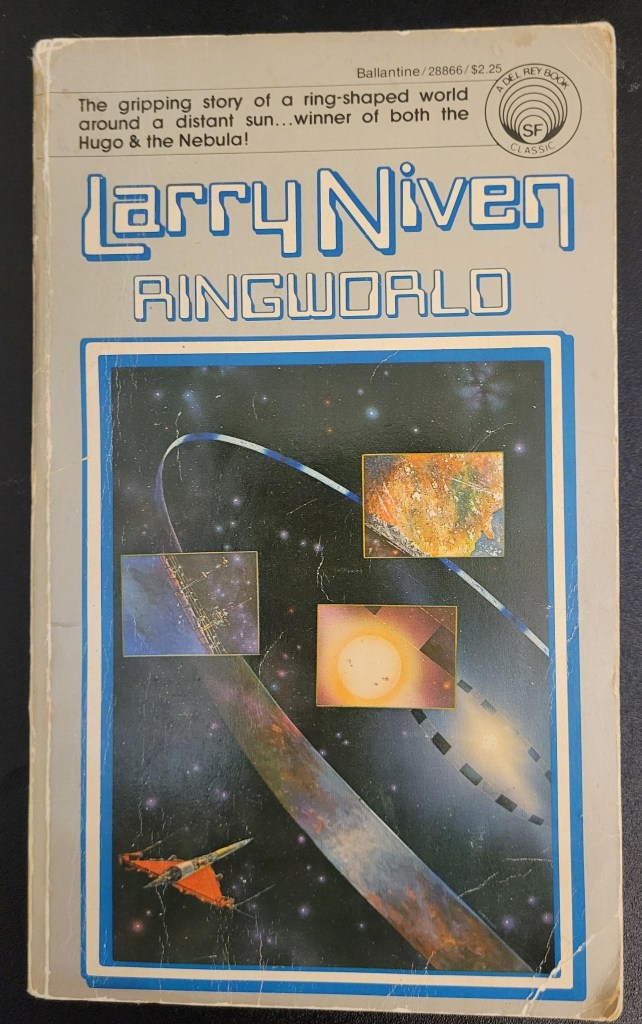
Ringworld – the quintessential “hard SF” novel.
For a long time, “hard science fiction” was almost all I read. (Think Andy Weir’s The Martian, or Jurassic Park.)
Back then I thought all fantasy other than Lord of the Rings was a waste of time. That shelf space could be better filled by the likes of Larry Niven and Poul Anderson, I figured.
Obvious science mistakes pissed me off. Han Solo “made the Kessel Run in less than 12 parsecs”? Please. Parsecs are a distance measurement.
Which gets to the heart of my snobbery about hard SF.
I wanted the science to WORK. I wanted to believe the adventures I read about were at least possible.
Walters and Vervaeke get into the Hugo Awards controversy. The Sad Puppies, protectors of the old guard, battled it out with writers and fans who wanted to expand the definition of science fiction.
There was a time when I would’ve rooted for the Sad Puppies. Walters was close to the mark when he speculated that the fight is really about personal fantasies.
I had a personal fantasy that I was almost unconscious of. Science fiction helped me deal with existential angst.
I might not get to be the adventurer in that somewhat scientifically accurate sci fi novel, but one day someone would.
A lot of people are mad at John C. Wright over his role in the Hugo Awards fight, but his Golden Ocumene trilogy is pretty damn good. I’ve read it and I got my mother to read it.
It bothered me to know the sun would swallow the earth one day. I coudn’t handle the idea of human extinction, even billions of years in the future. I thought, why not colonize the stars and outlive the sun?
Good Christian or not, I kept that possibility in my back pocket just in case. I wanted to go to heaven. But failing that, I thought maybe science would give us a kind of immortality.
The reason I never got laid in college.
A few stars seemed to be within reach. When I took Astronomy in college, I made a little chart of some of the likely candidates. Anti-matter might not take us as far as it took the Enterprise, but 3 or 4 light years ought to be doable. Right?
And once we had a couple of nearby stars under our belts, who knew what we might accomplish. I still have to scratch that itch sometimes. Movies and shows that do that for me are far too few.
Movies like Ex Machina, Interstellar and series like The Last of Us and Westworld kind of do it for me. I also enjoy watching videos by futurist Isaac Arthur, who explores those massive engineering feats that might be possible if we put resources and effort into them.
Futurist Isaac Arthur digs into one of my favorite concepts: the space elevator, something I think humanity could, and should pull off. If there’s one thing I haven’t changed my mind about, it’s that: we must continue to fund space technology.
When it comes to science fiction novels, I’m a lot less interested in the scientific rigor than I used to be, especially now that I understand how hard it is to separate perception from reality.
Phillip K. Dick is more my speed these days when it comes to sci fi. I figure if we can’t figure out the human mind and tame our irrational behavior, there isn’t much chance of accomplishing those grand projects anyway.
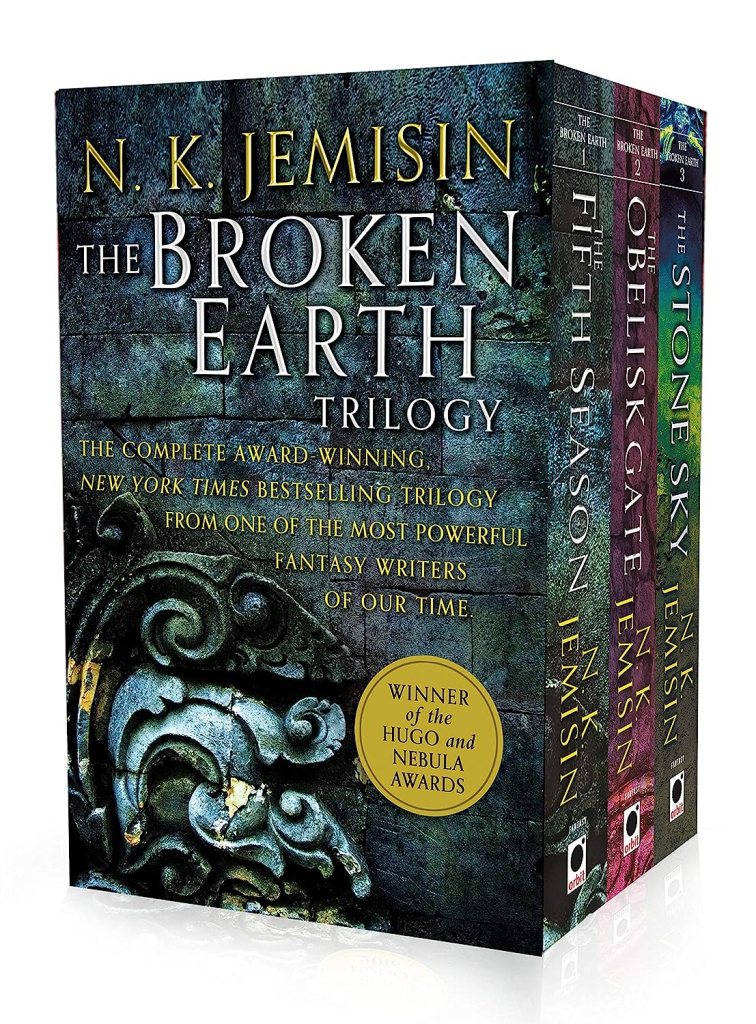
I’m no longer particular about how I define science fiction. I really enjoyed N.K Jemisen’s Hugo Award-winning Broken Earth Trilogy, which contained a lot of fantasy elements. (The world-building was incredible.)
New Weird also does for me what science fiction used to do, with elements of science fiction, fantasy and horror.
Annihilation, from Jeff Vandermeer’s Southern Reach trilogy is a good example. Perdido Street Station by China Mieville is another. They seem rather appropriate for the times we’re in. How to deal with the world when it makes no sense…
What does AI “see” when it models human behavior? If AI became truly sentient would we even be able to tell?
You’ve probably heard of the Uncanny Valley, the idea that robots or animated characters get creepier and creepier the closer they look to actual humans.
But is there such a thing as “inverse uncanny valley”? Where we react negatively to what an AI thinks of us?
Benjamin Bratten, a guy who is way smarter than I am, believes so. People do seem to judge “human” behaviors from AI as disturbing or inaccurate. Bratten thinks this might not be because the AI is inaccurate, but that it’s not the reflection we wanted to see.
He has some other interesting ideas as well. Like how it’s a mistake to define machine intelligence based on how closely it resembles human consciousness when we don’t actually understand human consciousness.
Instead of trying to create copies of ourselves, maybe we should just let them become intelligent by doing what they do best, which is finding patterns we are incapable of recognizing.
Maybe we should interact with AI’s with the understanding that they are not conscious in a human way. When we do think we detect empathy in them, that doesn’t mean they have it. It is easier to make it seem like they have it because we project on them what we want to see.
Maybe we should quit being so human-centric and admit there is more than one way of being intelligent? #UncannyValley, #AI, #ArtificialIntelligence, #Consciousness, #Intelligence, #Sentience #Computers, #BenjaminBratten
A few years ago I wondered if there was a chance I could convert myself from math ignoramus to math genius overnight. In my, let’s face it, old age.
I got the idea after seeing a documentary about Jason Padgett, a man who was basically the guy in the Pink Floyd song kicking around on a piece of ground. Then he became a genius after some guys kicked the shit out of him outside a bar.
After hearing him talk about how differently it made him see the world, I got jealous. I got partway into an algebra course on Khan Academy, before I realized I was using up my precious reserve of old man life force.
Only way it was ever gonna happen was to get kicked in the head, and most of the people who get kicked in the head that hard don’t become any kind of genius. Plus I’m allergic to getting kicked in the head.
Still I have this thing where I see things by people who do know what the hell they’re talking about and I want to understand it. No one told me in 9th grade algebra that I could use that shit on computers one day. They didn’t even have them in our school till the year after I graduated.
I wrote all my news articles on a manual Royal typewriter my first couple of years in the business. I’ll just have to settle for watching videos by people smarter than me and talking out of my ass. I’m WAY more talented at that skill.
So I am so tripping right now. I just found out about muonium. It’s lighter than regular matter and has nothing to do with cows. Why do I care? I don’t know. I’m a little high. And a lot nerdy.
I barely learned about muons a few months ago. Another one of those atom smasher stories. That was hard enough for me to wrap my head around.
Usually, “they just discovered a particle” quantum physics news goes in one ear and out the other. I can’t keep up with all the subatomic particles they keep finding in labs. It’s voodoo to me at this point.
I pay attention to science news, but they keep finding things out. When I was in school, atoms looked like the solar system. People on the news were going nuts over something called a God particle a while back, but I didn’t bother to dig into it. I usually don’t care as long as it’s not gonna blow me up. I might get curious about it later.
Muons grabbed my attention, because they already have a commercial use. Like electrons only bigger? Still trippy, but particles you can shoot at stuff is something I get. They have lasers now.
Now I find out there’s a kind of matter called muonium, like a little bitty atom. With an anti-muon (anti-matter!) and an electron. So it’s an “atom” that’s lighter than hydrogen. It’s another one of those things in the atom smasher that lasts a fraction of a second, but it’s long enough to make compounds like muonium chloride and Sodium Muonide (!). It’s too much for my brain.
They discovered it in 1960. Never came up in school. That kinda pisses me off. Anyway, it’s all of my life late, but now I know another physics thing. Now when are they going to figure our how to make something out of it?








 Late Boomer's Den
You must be logged in to post a comment.