Divided cities are an interesting phenomenon. You have cities that grow and merge, and cities that split apart, usually because of politics. They differ in their level of connectedness.
For a while we had East and West Berlin, with a wall in between. Until the 1870s Budapest, Hungary was Buda and Pest, with the Danube River in between.
In America, we have a lot of “twin” cities. In Texas we have the Dallas-Fort Worth Metroplex and Midland-Odessa.
Usually one of the cities in a “twin” relationship is more working class than the other, but when you come down to it, they’re still American. American culture, American social norms.
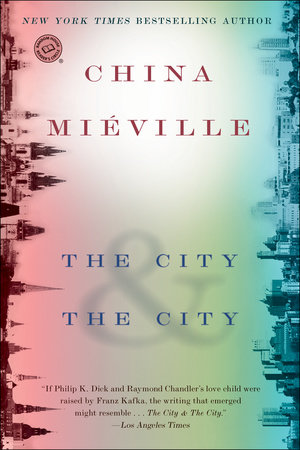
In The City and the City, China Miéville writes about fictitious cities Besz and Ul Qoma. The cities are physically adjacent – they have many “cross-hatched” regions – but their societies are kept strictly separated. This, despite the fact that they share streets, highways and railways,
By mutual agreement of Besz and Ul Qoma, a mysterious entity called Breach keeps citizens from mingling and interacting, on pain of arrest or worse. And you never know if Breach is watching.
The City and the City is a murder mystery that develops into an interesting study of society and law. A body is found in a crosshatched area. Did the crime occur in Besz or Ul Qoma and did anybody “breach”?
And could there be a mysterious third city flying under the radar?
Citizens of both cities have to be trained from childhood to purposely ignore any person or thing not of their city. Citizens learn to “unsee” (and even unsmell!) anything that doesn’t belong in their city. There are unificationist groups in both cities, but they are treated as radicals and suppressed.
It’s crazy when you think about it, how much the concept of a border depends on belief. There may be a fence or a wall or a line on a map, but the earth doesn’t care. It’s people who make borders happen.
I enjoyed the murder mystery and protagonist Tyador’s detective work, but the conceptual stuff was especially interesting. Enforcing a border via psychology.
Unseeing. Pretending you didn’t see to the point that for practical purposes you didn’t. Is that really possible?
It got me thinking of anti-memes – objects, creatures and phenomena that use forgettability as camouflage. qntm’s novel There Is No Antimemetics Division, takes that concept to ridiculous and extremes, but “anti-memetic” does seem to be a thing. Can you describe the last panhandler you saw while driving? Probably not. I can’t.
I actually forgot an entire city. I was talking about twin cities and totally forgot that El Paso, where I live is exactly such a city, or half-city. The Rio Grande officially separates El Paso from Juarez, as well as U.S. from Mexico. But the real separation is cultural.
Borders are imaginary until you make them solid, but still in the most important ways, they’re imaginary. Before it was part of the U.S., Texas has been territory of Spain, France, Mexico, itself, the Confederacy and the territory of various native American peoples.
Who will claim it in 1,000 years? It won’t be more than a claim. The earth doesn’t care about lines on maps.
Lajitas was a good place to camp back then, when you wanted to do West Texas stuff in the Big Bend area. But back then there weren’t that many people around. There were times when it felt like you had the whole desert to yourself.
I spent a number of weekends there, so the memories get jumbled together, but I miss that era that will never come again. Back in the ’80s when the border was (mostly) chill.
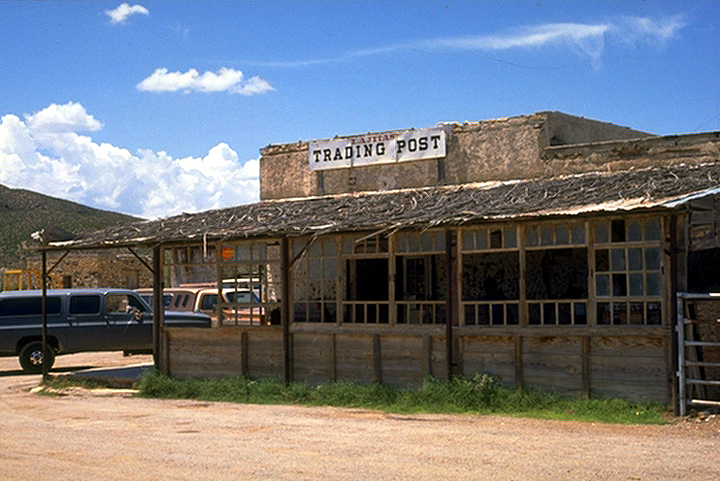
I remember hanging out in front of the old Trading Post at sunset with my uncle and his friends. There were bullet holes in the ouside wall, from Pancho Villa’s men, so they told us.
There was a pool table outside. Not very level, but you could play when the store was closed. I remember somebody put on the Willie Nelson version of “Pancho and Lefty,” which felt like a perfect way to close a day.
The area got to feel like a neighborhood after a while. Distances are relative. On the River Road was “Big Hill.” Just a yellow highway department sign really, but we made it a proper name.
You made sure to see “DOM,” letters scraped into a cliff face during the filming of Fandango, my favorite Kevin Costner movie.
There was a place on the side of the road where you could get out and look down at the Rio Grande, waaaaay down. You might go to La Kiva restaurant in Terlingua – still remember the bones of a “Penisaurus Erectus” embedded in the wall.
There was a village across the river in Mexico where you could pay a few bucks and a man with arms like tree trunks would row you across, where you could eat dinner at Garcia’s. In an adobe building with no running water. The food was delicious.
There was a blonde teenager they called Panchita who spent most of her time on the Mexican side in a little curio shop with no customers, listening to corridos and rancheras on the radio.
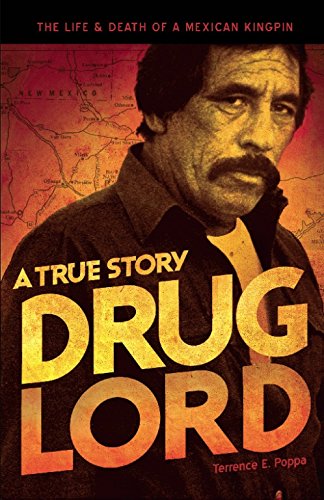
When I read Terrence Poppa’s Drug Lord, Life and Death of a Mexican Kingpin I wondered if Panchita might’ve been the daughter of an American lady mentioned in the book.
From what I was told, Lajitas and the village were basically connected. Tourists went to dinner in Mexico. Families from the village would cross the river sometimes just for something to do, like watch bootleg American movies before the copyright cops put a stop to it.
Los Tigres Del Norte – El Zorro De Ojinaga (The Fox of Ojinaga). A corrido about the drug kingpin who ruled much of the trade of marijuana and cocaine between Mexico and the US before the advent of the cartels.
The barker in front of the club called out with heavy reverb, “El B29-nine nine nine… Beeg surprise tonight-night-night…”
There was a big surprise all right, but not the one he meant. This was in the ‘80s, while I was on break from college. My first and last visit to Boys Town.
My uncle and a couple of his friends had invited me to go whitewater rafting on the Rio Grande, back when it had water.
After a long drive through West Texas, we arrived at our campsite in Lajitas on a Friday afternoon. We had some time on our hands and decided to go out for dinner, so we headed to the international bridge in Presidio.
We figured we would eat dinner at the train station in OJ, then check out Boys Town.
OJ was our nickname for Ojinaga. Boys Town was what everybody called the red light district. OJ’s red light district wasn’t as famous as the one in Acuña, but it had an anything goes reputation.
Going to Mexico was easy in the 80s. No passport, no fussing about walls. My uncle didn’t want to take his truck across, so we caught a ride from a resident on his way home for the evening.
We tapped the side of his pickup and he signaled for us to hop in the back. Common courtesy back then. He drove us to the checkpoint. From there, we walked to the end of the bridge where we found a taxi waiting.
He drove us to the train station, and agreed to return in an hour and take us to Boys Town. We finished dinner early and thought, why not catch a ride from the taxi parked out front? A taxi is a taxi, right?
We struck up a friendship with Driver Two, who I’ll call Roberto. He didn’t speak English, but my uncle’s friend Mando translated. He had a lot to say about Boys Town and how the girls there all liked white meat.
After a surprisingly long ride, we arrived at a collection of bars and clubs. He dropped us off and agreed to come back in a couple of hours.
The first bar was quiet and nearly empty. We chatted with the lady at the bar, who had a really cool bracelet made from old Pesos.
About half a beer later, a man burst in the door and tapped Mando on the back, hard. Taxi driver Number One had found us and he was pissed! Behind him was a cop with some kind of assault rifle.
“You made me come all the way back to the train station and you weren’t there,” he said in Spanish. “You’re paying my fare!”
Mando relayed the message. No arguments from us. We didn’t even bother to count. We just grabbed whatever bills we had and put them in his hand till he went away.
Lesson learned. Wait for your taxi.
We weren’t ready when Roberto came to get us. Mexico partied late! The strip clubs weren’t even open. He said he’d find us on his next trip out.
We looked for a more happening bar and figured, why not see a strip show? We weren’t there for the brothels. The barker at B29 Cabaret got our attention. What was the big surprise?
It was dark inside. My uncle and his buddies found a table and ordered a round of Dos Equis for themselves and a bottle of Coke for me.
Then an inebriated man at another table motioned for me to come over. Why me and for what? I was nervous as hell, but I went.
All he did was stick out his hand and say, “Americano.” He apparently liked the look of me and wanted to shake hands with an American. That memory really stuck with me.
Several beers and Cokes later, Roberto turned up. We still weren’t ready. He’d made several runs to OJ and back, but we still hadn’t seen a show. They were trying to find out how much beer they could sell us.
We invited Roberto to sit at our table and bought him a beer. He settled in and had several. He’d picked up enough fares for the night and was there to party.
After a while he got up and hollered. “Bring out the girls!” he said in Spanish. “These gringos want to see a show!”
And was there ever a show. Three girls came out and danced on the stage, then came out on the floor, between the tables, including ours. I’m sure I was blushing.
I thought they were cute, but I didn’t enjoy it as much as expected. I could tell they didn’t want to be there. They wouldn’t look you in the eye.
Then Spanish classical music began playing and out came a tall woman in a fancy dress and headdress. She wore a lot of makeup and had long, false eyelashes.
She held up a fan and performed a classical dance, demure, but flirty.
Then the DJ put on something with a beat. She thrusted her pelvis and gave all the drunks the come-on. She lifted her dress and did something with her high-heeled shoe. I saw a lot of tongue.
Then ta da! She tore off her top, took off her wig and took a bow. She was a he. My uncle and his buddies’ mouths were hanging open.
They were older than me and had their beer goggles on. I’d been drinking Cokes all night. I thought he was a woman, but too old for me and wearing too much makeup.
I just thought, huh. I guess that was the “beeg surprise.”
There were no more girls, but the night was far from over. A conjunto band started up. Mexican men wearing oversized cowboy hats and buckles danced with their wives (or girlfriends more likely). Roberto got up and spoke to the band.
We were all exhausted except Roberto. He was into the music. “I’m waiting to hear my song, then we can go,” he said. I was about to fall asleep.
All of a sudden, “Crash!” A man threw a metal chair in the center of the room, cursed in Spanish and stomped out and nearly slammed the door off its hinges.
I thought “Oh shit! Which way is north? Am I gonna have to walk to the border? What if he comes back in with a gun and starts blasting?”
But apparently that was par for the course at the B29. The band played another song and folks went back to their cervezas.
“We can go now,” Roberto said with a grin. He and the band had given us the REAL surprise.
He filled us in on the way back to OJ. The federales has just killed the local druglord in a shootout. The man who threw the chair was the druglord’s brother.
Roberto recognized him and thought it would be great fun to request a corrido about the shootout. Roberto wasn’t afraid of much apparently.
Incidentally, I read Druglord: Life and Death of a Mexican Kingpin, by Terrence Poppa in the ‘90s and learned a few things about that night. The druglord who got shot had to be Pablo Acosta, who turns up in the Netflix show Narcos Mexico.
I haven’t found anything about Pablo having a brother, so maybe the guy meant compadre or associate. I don’t know who the band was, but the song was almost certainly “El Zorro de Ojinaga,” made famous by Los Tigres Del Norte.
Not sure what the cab driver’s deal was or why the chair thrower was so pissed. The song makes Acosta a tragic hero as far as I can tell. I reckon he must have had enemies though. Maybe it was just a case of “too soon.”
My dad spent a lot of time outdoors and knew a lot about the wildlife of Texas, including the kind of critters most folks just step on or ignore.
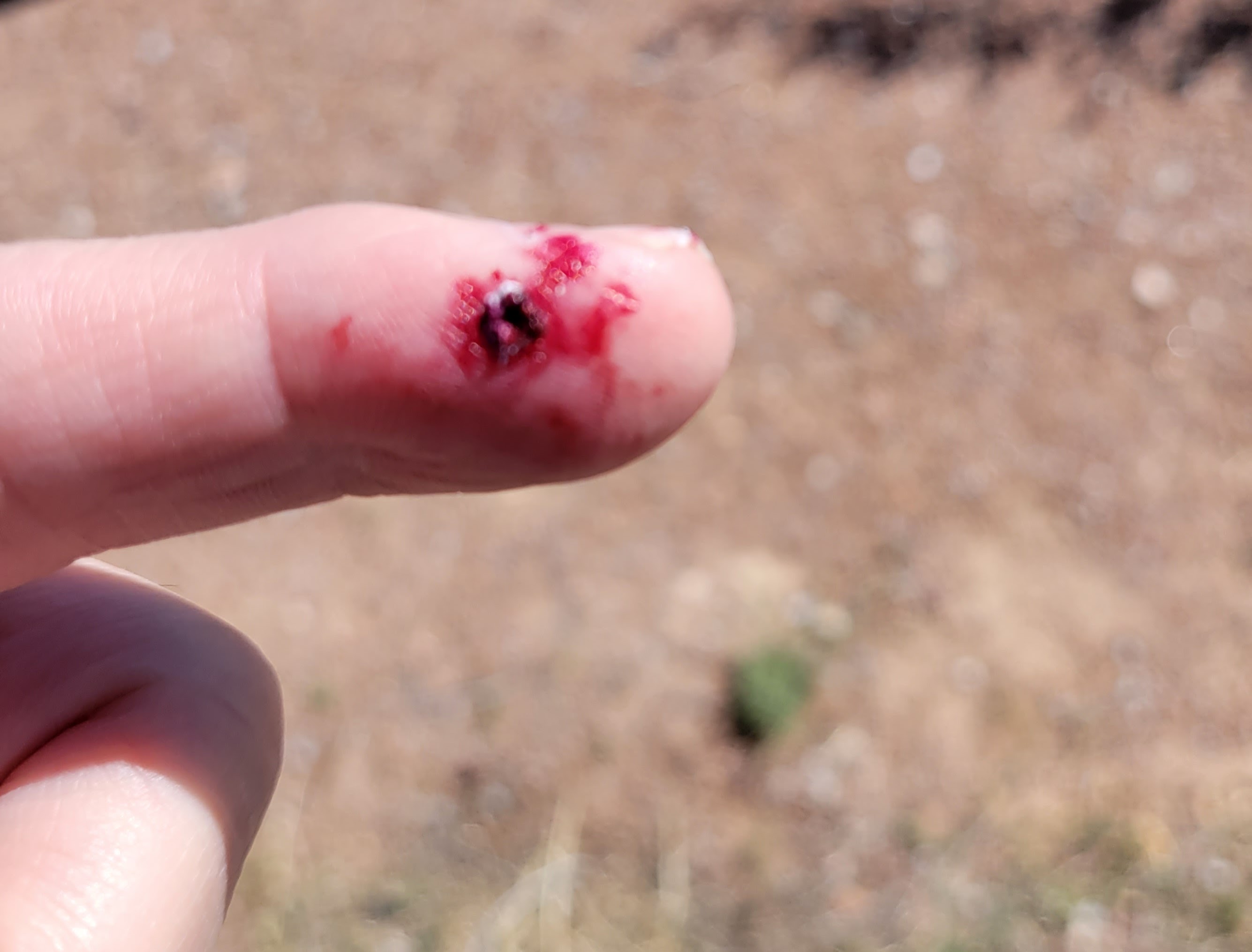
Each of those white spots on the lower pad are hiding cochineal bugs, source of an important red dye.
Dad knew which ones were harmful, which ones were useful. He loved seeing ladybugs and praying mantises in the garden. He taught me to be curious.
Once he scraped some white web-like stuff from the pad of a prickly pear cactus with a stick. “Inside each one of those spots is an insect called a cochineal bug. Indians used to get red dye from it.”
Dad didn’t like to squish bugs willy-nilly and neither do I – I’m the kinda guy who rescues insects from scared ladies – but that was a pretty neat discovery.
Sorry little bug. I promise I won’t do it again.
Now when I see those white spots on the pads of a prickly pear, I know what they are. And they’re not just a curiosity. Cochineal bugs are still important.
They’re the source of the natural dye carmine. You probably ate or drank some of it today.
It’s been a source of income in Mexico for a long time apparently. It’s a tradition I hope they can keep alive. Apparently that’s up in the air at the moment.
Interesting video about how cochineal bugs are cultivated in Mexico to produce the natural food dye known as carmine.
The version of the song I learned was Johnny Verbeck, ot Johnny Rebeck. But I didn’t learn the last verse where the people ate the sausage anyway. That makes it so much funnier!
Just got a text from someone who was freaking out over the kidnapping and murders of Americas that just happened across from Brownsville in Matamoros.
“Don’t go to Mexico anymore! Get your dental work done over here!”
I saw the video she was talking about it and I hated it, just like all the violence I see on my screens these days. But I reminded her: We both used to work in the paper business.
We got to see the sausage being made.
If there was a murder in town, newspapers sold like hotcakes. If you reported on all the murders that didn’t happen, you’d run out of paper.
If you’re doing journalism for the right reasons, you cover what you need to cover, whether it sells or not, but we knew damn well which stories management liked.
To be fair, I got excited about stories like that too, at least at the beginning. But these days too many people are getting their news from sources that scare them all day long. If you’re scared all the time and you don’t get to enjoy life.
I like sausage. Sausage is tasty. But don’t kid yourself that it’s health food. Every place I worked tried to make good sausage. But it was still sausage.

 Late Boomer's Den
You must be logged in to post a comment.