I’ve made a habit of writing down my dreams when I can remember them. I figure it might help me be a little more creative. I’ve had a few “hits,” ones I’ll remember for a while, but to be honest they can be a bit repetitive.
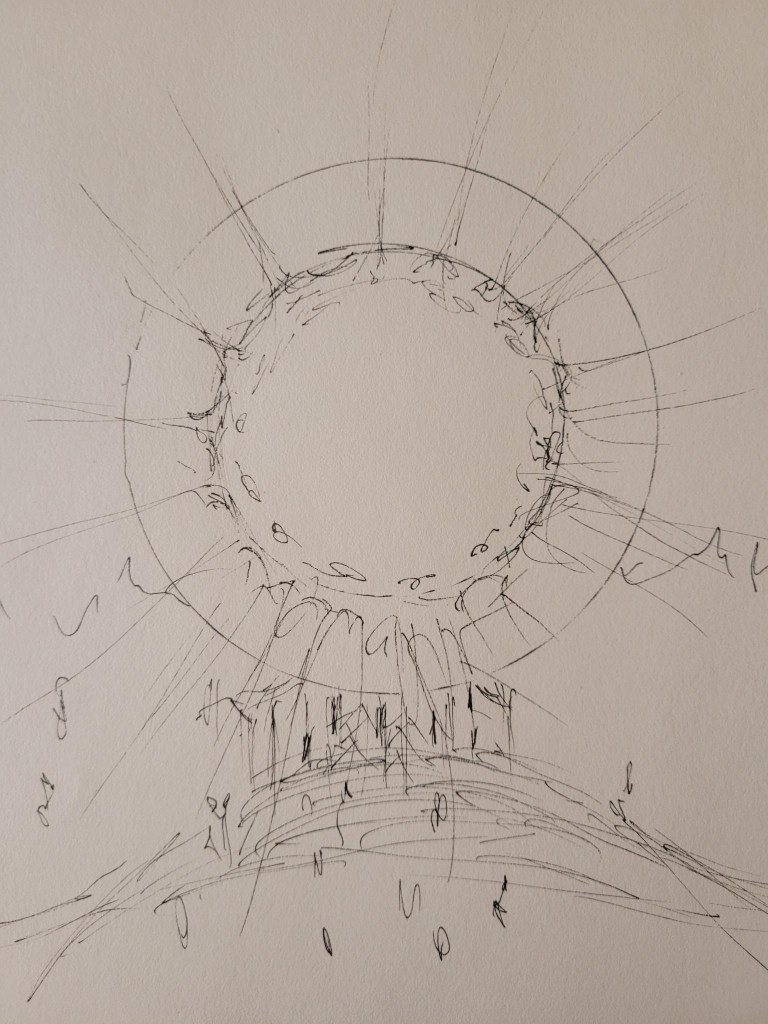
I’ve noticed a pattern over the last several weeks: dreams that feature a “reality generator.” Pretty derivative really. They one I remember most clearly looked like a big metal donut, mounted on the back of a military vehicle.
I had helped create it, but was I was now unsure if that was a good thing. It was designed to project a worldview on the population. I was told there had been other versions, but this one was more powerful and worked on more people.
Pretty sure the donut shape was a ripoff of the “Everything Bagel” in Everything Everywhere All At Once. One day they’ll find a way to sue you for dream plagiarism, but we’re not there yet. Anyway mine looked more like a steel washer.
Last night I dreamed about a “reality generator” that at least didn’t plagiarize anybody’s design. This one consisted of steel poles planted in a circle with bends at the top, pointing inward. It replaced a less effective version that had been planted by a crooked cop.
The purpose of this “reality generator” was to eliminate suspicion and allow criminal activity to go unnoticed. Obviously inspired by Ozark which I watched last night. (No spoilers. I’m still in season 3.)
I have about figured out what these dreams are actually about. Perception, the only reality we humans know. You can’t make a reality generator, but a perception generator? We’re using one right now.
Propaganda, misdirection, dots connected every which way, like new constellations in a sky with too many stars. That’s what the Internet is giving us. A simulation that can look like literally anything.
Fortunately you carry a reality generator in your head. If you can resist all the “realities” blasting into your eyeballs, you might get close to the one that machine can’t touch.
It’s been one hell of a coke binge so far hasn’t it? Smart phones, social media wars, Silicon Valley tyrants rearranging our lives as they try to squeeze out every last second of our attention. When will it end?
I don’t know about anyone else, but I’m feeling rather strung out at the moment.
There’s a phenomenon scuba divers have to watch out for called nitrogen narcosis. Below certain depths, the nitrogen in your body becomes an intoxicant.
Rapture of the Deep, they call it. You can get so out of it, you’ll try to offer your regulator to a fish, swim down, when you need to swim up, etc.
Not that I ever went scuba diving, but I think it’s comparable to what we’re all doing here on land. Doomscroll Narcosis. Rapture of the Screen. You’re in too deep, but you just keep diving deeper and forget to come up for air.
I’m as guilty as anyone. I tear myself away from the phone, take icons off the home screen, set alarms and rules, try to instill a little self-discipline then I find myself doing it again. From content to content, switching between Facebook, YouTube, Mastodon and back again.
By the time I snap out of it, half the day is gone and I can’t string words into a coherent sentence.
“This is your brain on technology… Any questions?”
I am seeing some signs that we might overcome this mess. I’m seeing some really substantive YouTube channels that seem to be growing, slowly.
All this dopamine seeking behavior isn’t giving any of us the meaning we seek.
I have a hope that enough people have enough of the mindlessness and go looking for the real deal. The stuff that helps us figure out who and what we are, that make a hard life worth putting up with.
People like John Vervaeke with his Awakening from the Meaning Crisis series on the development of Western philosophy, Damien Walter with his thoughtful critiques of science fiction storytelling.
I think they’re onto something. It takes effort to explore their work, but it’s worth it. There’s spiritual food to be had online from people not obsessed with overnight success. Eventually people will quit binging on internet candy and go looking for it.
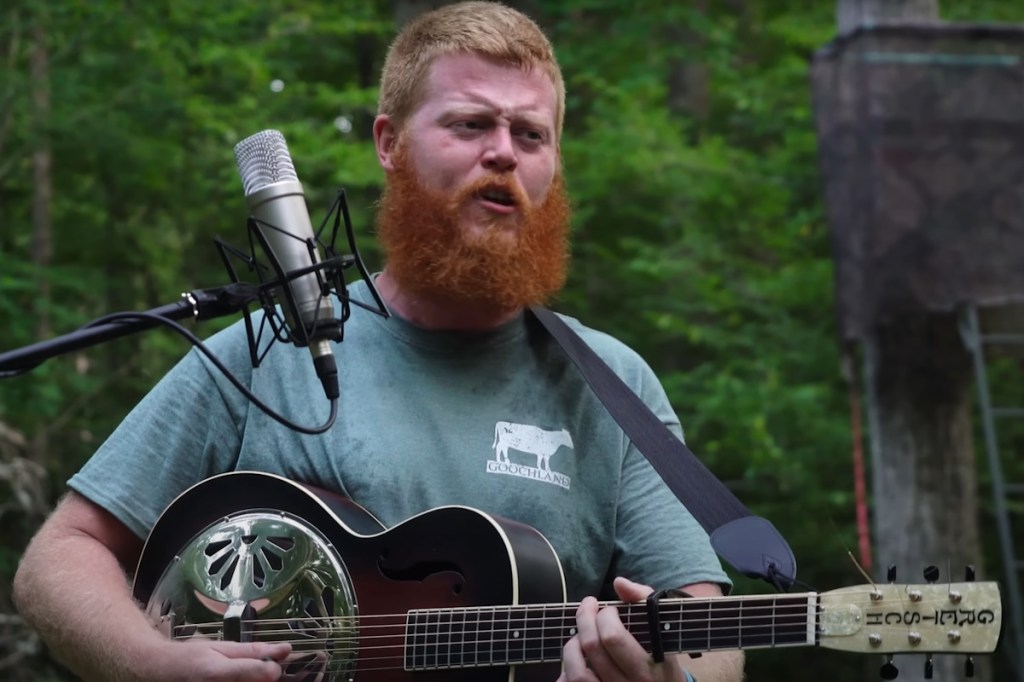
The internet squabble over Oliver Anthony’s song “Rich Men North of Richmond” really got under my skin. I already wrote about him, but I wasn’t done. I couldn’t write about anything else until I got it out of my system.
I’ve always been a contrarian. Sometimes I stick up for the wrong people and get egg on my face. Maybe it’ll happen again. But I’d rather be a contrarian for undeserved empathy than undeserved cruelty. I hate having to choose between mobs.
“I Want to Go Home” really gets me in the feels, with that line about the grandkid selling the family farm and seeing “only got concrete growin’ around.” People in the country do get attached to the land. The system doesn’t like that.
Instead of dwelling on what Oliver Anthony’s agenda was, I decided to take a deeper dive and see what I thought of him as a musician. I’m a fan of his type of music. Based on the dozen or so very good song he’s been uploading for the past three years, I don’t see an agenda. As far as I can tell he’s just been following the muse and got caught up in other peoples’ fight.
This comment on his Facebook page doesn’t sound something a would-be culture warrior would say: “I HATE the way the Internet has divided all of us. The Internet is a parasite, that infects the minds of humans and has their way with them. Hours wasted, goals forgotten, loved ones sitting in houses with each other distracted all day by technology made by the hands of other poor souls in sweat shops in a foreign land.”
I can’t help but notice he’s Appalachian. A culture that has influenced a lot of America, but doesn’t seem to get much respect. There are reasons why he and his fans think the way they do.
She talks about exploitation by the timber, mining and pharmaceutical industries.
What I found interesting was her explanation of how money-based economies and governments try to urge people from land-based cultures into the city, and how that has resulted in a superiority complex among city dwellers and internalized shame among country folk.
Oliver Anthony – Rich Man’s Gold. I like the tone of this song. “You weren’t born to just pay bills and die…”
As for those lines about welfare… I watched his Joe Rogan interview and he said something interesting about “Rich Men North of Richmond.” He didn’t think it was his best song and was only half-finished when Radio WV chose it. He finished the second half in a hurry.
So I think he meant what he said, though not necessarily with any ill intent. It’s pretty much middle of the road thinking where he lives. I had similar views as a rural Texan, and I was a lot more liberal than the average Republican.
Why don’t people from Oliver Anthony’s demographic find progressives convincing?
It comes down to something Kingsolver said. “We will only take information from people we trust…. so if you open a conversation with ‘you bonehead’ the conversation is over.” In other words, they don’t trust the the messenger, so they don’t trust the message.
City culture is the mainstream culture of America. Most of our media comes from cities. But that’s not the only culture. People in the countryside don’t feel like city people aren’t on their side.
So they don’t trust what the mainstream says. That’s how the rich men north and south of Richmond are able to fool them. They pretend to care. If those rich men won’t lift a finger to help, at least they’re on the correct “side.”
What would it look like if progressives actually did care?
In the South, there is a custom where you want to have a little conversation first, before you get down to business. You talk about your kids, your dogs, your favorite music. Anything to establish a connection. I think that custom would come in very handy on social media.
If you dislike the messaging in “Rich Men North of Richmond,” and you find someone who likes it, what if you tried to make a connection instead of writing them off? You liked his voice, or maybe you like some of his other songs? Start there and maybe they’ll care what else you have to say.
Oliver Anthony – Ain’t Got a Dollar. I can vibe with this song. There is value in living on the land near where you grew up, instead of moving all over to chase a dollar.
I wonder if the message I’m getting from Devo’s song “Freedom of Choice” is the one they intended? They were prescient in a lot of ways – the whole concept of devolution seems to be panning out doesn’t it? So maybe…
I wonder if the paradox of choice occurred to them? The fact that once you get more than a certain number of choices, you actually have no choice at all. “Freedom of Choice is what you got. Freedom from choice is what you want.”
I always took that as a criticism of complacent Americans. Why do we let the powerful run over us the way we do? But that line, about the dog with two bones, “He’d lick the one, he’d lick the other. He went in circles, he dropped dead…”
I think it’s just a normal reaction to choice. What if the dog had to choose the best bone out of a trillion? That’s what we’re dealing with now. I’ve heard John Vervaeke use the term “combinatorially explosive” to describe the blast of sensory input human consciousness has to navigate.
A big part of what we do on a daily basis is ignore as much as we can and choose what we must, because otherwise we’d be unable to function. And still it’s too much for our brains.
Ideally you open your mind wide enough so you can choose the best option, but if the input continues to increase, at some point you get overwhelmed.
Things were complex enough in 1980 when that song came out. I always considered Devo to be when the modern age began. Now we have the Internet. I was blown away by all the choices at first. I discovered so much music, so many points of view I hadn’t considered.
But now I can see where it was all headed: Too. Many. Choices. Internet, it’s enough to melt your brain. You only have so much time and energy. So what do you do? Choose someone, or a collection of someones, to make choices for you.
You can still find enough variety in that narrow band of choices that it can feel like you’re getting the whole picture. Or as much of it as you need. But people you trust to make up your mind for you are in the same situation. So what are you likely to get? Choices that benefit them.
Tyrone Davis – If I Could Turn Back the Hands of Time
When I screwed up in the newspaper business, I ran corrections. I hated putting out wrong information, stories with typos or missing jumps. You might see them, you might not. But I tried.
The Internet has changed the whole concept of corrections. I’ve already made a few mistakes on this blog that I went back and fixed. I try to get to it before anyone catches it, but I always wonder. How many people saw both versions and are questioning their memories right now?
The Mandela Effect is such an interesting conspiracy theory. People claim to remember Mandela dying in prison instead of going on to become president of South Africa. Evidence for Doctor Who? If a time traveler tweaked the past what would happen to our memories? If you remembered something from another timeline, how could you ever prove it?
Memory is pretty fallible. I remember things wrong sometimes, who was there, who said what. But I don’t remember people attributing that to time travel until relatively recently.
It occurs to me the popularity of that idea – other than the fact it’s a fun theory – might have to do with the character of the Internet. Articles and social media comments disappear, giving people the opportunity to say “I never said that.”
Even on Wikipedia, which has a pretty good reputation for backing up its content, links to websites that no longer exist. Did that article exist and can you prove it? AI complicates things even further. I understand ChatGPT has been caught citing articles that never existed.
Kinda creepy isn’t it? Did I really see the thing or is it a figment of my imagination? Makes me wonder what that’s doing to society, that already disagrees over so many things.
Call me old fashioned, but I do believe reality has a ground floor and truth exists. Figuring out what those things are is another matter. It’s hard enough to do as it is. I’m afraid it’s going to get harder.
So now the Zoomers consider periods passive-aggressive… When I first saw this story my thought was, “Kids these days…” Like us old folks aren’t being tormented enough over the pronoun business.
But I’ll be damned if it didn’t make a lot of sense. There IS a difference between “we need to talk soon” and “we need to talk soon.” with a period. The second one might imply you need to make a phone call.
I’m not sure NBC totally got it. The kids aren’t eliminating periods, they’re changing the rules. Because somebody needed to.
What they’re doing is metacommunication, something digital communication is notoriously bad at. Now I think of it, the digital age has changed the way I write.
Looking over my text messages with my wife, I barely used any periods. I also purposely misuse ellipses soften a sentence. When I write a blog, I’m not scared to mix formal and slang.
Because because OMG who tf am I trying to impress?
I’m a lot more of a stickler for punctuation than a Zoomer because I’m older but my text messaging and my social media comments have gotten less formal over the years. (I’ve been online for nearly 30 years now… That blows my mind.)
For me its more of a case of “Oh I forgot a period” but why bother this isn’t for business. But I think this idea has legs. Maybe this could be adapted to get more nuance into social media? Being able to indicate “I’m not trying to start a fight” would be pretty damn helpful.
I think Internet’s troubles began when the boss got online. At first you knew your boss barely knew how to get online. Wasting the boss’s time was kind of an ongoing joke for years.
In the mid-90s, only one computer at my newspaper was connected. That was the boss’s computer and he only used it when someone from the head office demanded.
He hated the Internet, said it was a waste of time and he didn’t want to hear about it. You could get fired if you got caught using it. We had a newspaper to get out.
When smartphones came along and it became apparent that we were having too much fun at the boss’s expense, the boss’s boss, or the boss’s boss’s boss, thought “Hmm. Those peons aren’t just employees wasting company time. They’re a piggy bank we haven’t cracked yet. Maybe we can make back some of the money we have to pay them?”
Now every time I get online, I get a deluge of people trying to sell me something. Everything that used to be free, they’re telling me, “upgrade to premium! It’s just a few dollars a month!”
Now the Internet is a money-making machine and we’re both the product and the customer… Maybe the Internet is the boss and the company store all rolled into one?
Vlad Vexler on why it’s so difficult for someone to let go of an identity they’ve created for themselves even when it no longer makes sense – it feels like death.
Why do people become so extreme and resistent to change? Why do they not say, “enough!” when their leaders and role models go rogue? In a word: identity.
An identity is very hard to let go. I’ve been through that process more than once, and each time it was as if somebody died. Because they kind of did. Or more accurately, they melted into the rest of me.
But it was traumatic and I grieved. Suddenly I didn’t know who I was anymore or who my friends were. Ultimately, those changes made me a better, more whole person, but it’s a scary prospect. Too scary for many.
As we became more isolated in the real world, people began looking to the internet for a sense of identity and belonging. Social media algorithms naturally promote the most extreme positions, because they get the most engagement.
If you’ve attached your sense of self to a group of people who become convinced to follow an extreme ideology, you’re likely to go along.
I can go on an on about how the West seems to have lost its ability to think critically, but Vlad nails it so succinctly in the above video. In case you think I’m talking about the MAGA phenomenon, I am, sort of. But it’s not just about Trump. It’s about everyone.
I’ve seen this dynamic affect the left wing as well. Witness the drama and infighting over the last few years among progressive YouTube creators. I respect a lot of them for their ideas, but I’ve learned not to let them or their communities decide who I am. That’s not up to them.
I can’t let myself get pinned down by groups that become dogmatic or that violate my principles, because then I can’t grow. There were times in my life when I thought I reached my final form, but that always turned out to be an illusion. I’m 58 years old, but I have not stopped growing, and I don’t intend to.
My wife and I were talking about how horrible it would be if the post “My Hair Is Up Here” went viral. The one where I look like a beached whale with strategically placed cat.
I don’t know why some people like being viral. It looks horrifying. Anything you get out of it is a devil’s bargain.
I would have to put the blog on hiatus and get off the grid till it blew over. I want to write. I don’t want to talk to “media” about my looks.
I want to get famous for my mind not my body.
Right wing media would be like, “So this is what liberal culture has come to.” I don’t know what lefties would do, but they’re so mean to one another I don’t want to know. They are a feisty bunch.
“On the Computer” – by Treasure Mammal. A song from a more innocent age. I saw these guys during “Yeast by Sweet Beast” in Austin and they were so fun.
I fell in love with the Internet, even though it nearly put me in the street. I was in denial for years. Newspapers would adapt. Only the dailies had to worry. The weeklies and semi-weeklies would always be in demand.
It looked like my salvation at first. It was a wild and sometimes dangerous place, but it was exciting. So much knowledge, so many possibilities.
The Internet let me experience a world I couldn’t afford to travel to. I lived most of my life in small country towns, always broke. People weren’t interested in my favorite bands or sci fi books. They never seemed to get my jokes.
On the Internet I found my people. Or thought I had. I could talk to other music geeks and women who weren’t looking to marry a church-going cowboy.
I wasn’t a liberal, but I got along with liberals. They were usually good for a band rec. Even during the Iraq War you could agree to disagree.
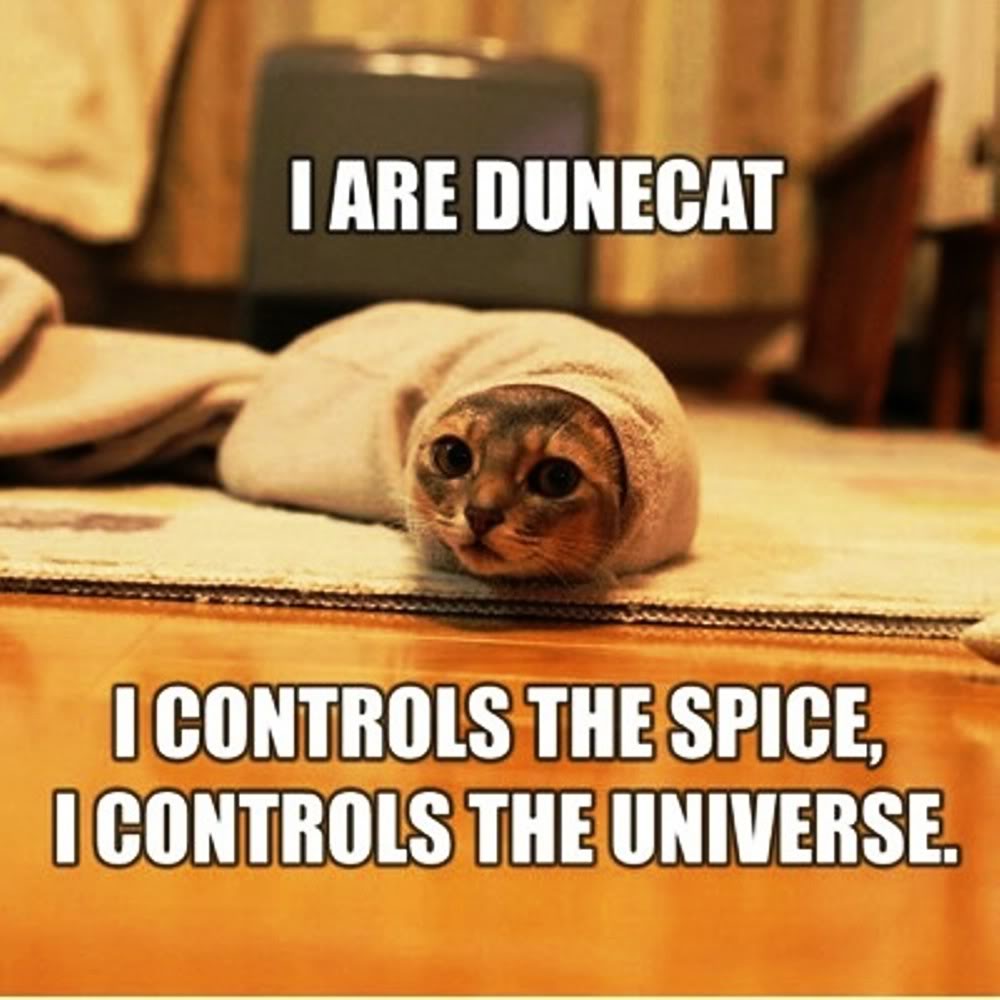
Looking back, I feel so naïve. I thought it would always be about LOLcats and David After the Dentist and Charlie Bit My Finger. I might have been helping to put myself out of a job, but it kept me sane. For a time.
Now it feels like the hot stripper girlfriend who stalks my every move and keeps slashing my tires. I should probably hide someplace she will never find me, but I keep waiting for the magic to return.
What are we gonna do with this thing we’ve created together?
#Internet, #LOLcats, #Newspapers, #Yeast By Sweet Beast, #Treasure Mammal, #Traps
 Late Boomer's Den
You must be logged in to post a comment.