I just finished watching an astronomy video from one of my favorite science YouTubers, Anton Petrov.
Did you know we’re not just in the Milky Way, but part of of a galactic super cluster called Laniakea? Which is only one of many such super clusters?
Learning how small humans are in the scheme of things can be humbling or it can be humiliating.
I see it as humbling, and at the same time inspiring. How amazing that we’ve learned as much as we have. How far we’ve been able to see into time and space.
It’s as if the creatures I used to look at in the microscope had mapped the inside of my house. Could you imagine? If any extra-dimensional beings are studying us, I think they would have to be impressed.
On a slightly related note, I just thought of Blood Music, a wild science fiction novel by Greg Bear where single-celled life becomes as intelligent as us thanks to carelessness in a lab. It starts as a Horror Story as colonies of cells begin rearranging the earth.
Then it becomes a complete mind-fuck as the microsopic world discovers and learns to communicate with humanity. And the weight of their strange concept of physics begins to change the universe.
Too bad this movie came out during the Pandemic. More people should’ve seen it. I discovered it at just the right time for me.
I was walking in a little park with my wife not long after the Great Texas Freeze of 2021. Just a well-kept park with grass and a few trees. The city was recovering and the weather was nice again. The sun was setting and it was glorious.
Suddenly I felt like I was in the movie Coco. Everything felt very Mexican, then very Aztec. There were hidden symbols everywhere. I was a white guy in a quiet neighborhood – and an Indian from Mexico on a sacred quest.
The shrooms were kicking in. Time to head home.
The ghost of some graffiti the city had power-washed off the sidewalk popped out in 3-D. It reminded me of a goat, with a fish tail, like a mermaid. It meant something, I couldn’t figure out what.
About halfway home, a couple approached on the sidewalk, which made me nervous. Covid and the street violence on TV made me leery of people. They were Indians from India, out for a walk.
When we passed they smiled and I thought, good, they’re from a friendly tribe.
As we crossed a bridge, the sky darkened and so did my mood. I noticed how polluted and full of trash the creek was and I thought, “Blasphemy. How can we do that to our Mother?” I felt sick.
Then I wept because I wasn’t an Indian at all, or really anything. I was a white man from the country, living in a city full of concrete and asphalt. I didn’t have a tribe. I liked the culture of the city, but I didn’t belong. I missed the trees. I missed the wildlife. My wife grew up in the city and didn’t understand.
And I thought, how was that not a tribe? If you look at it that way, I’ve belonged to several over the years – rural, suburbanite, city dweller, conservative, liberal, progressive. Or anyway I tried to belong.
I hated seeing all the tribes of America at each other’s throats – when as Americans, especially white Americans, we’re all faced with the same difficult question: Who the hell are we?
I had just watched News of the World, the Tom Hanks movie about Texas during Reconstruction. Captain Kidd, Tom Hanks’ character, earns a living riding treacherous roads from town to town, reading newspaper articles to war weary citizens.
Kidd agrees to take on a twice orphaned German girl. Her parents were killed by Kiowa, who adopted her. They were then killed by Union soldiers who were busy running the Native Americans off their land. He takes her to her German relatives, but it doesn’t work out. She’s not one of them anymore.
There’s a scene where the girl wails at the Kiowa to come back as they ride across the Red River on their way to Oklahoma. But they can’t. The river is flooding. That part of her life was over forever. I felt that little girl’s pain. She had lost her connection to the earth. She’d become like us.
Those of us who come from settlers-on-other-peoples’-land have a little bit of that suffering in our hearts, whether we admit it or not. Not just because of guilt over the things our ancestors did, over slavery, over the Indians, but because of loss.
The continent modernized and towns became cities. Folks left their farms and got work in factories. They fought in modern wars. They became modern people, and they lost the earth.
The process continues as the cities devour our little towns, as the stores shutter and the populations plummet. Cities are important, the engines of our civilization. We need their culture. They’re a sanctuary for some of us. But if you ever lived outside a city you know: cities eat towns.
Leaving a town for the city wasn’t the leap that it was for settlers who left the frontier. We had running water and electricity after all. A lot of us went to college. But we lost the places where it felt like we mattered. And we’re that much further from the earth.
Some of us try to compromise, move to the suburbs, buy big trucks, listen to country music and pretend it’s about us, but we know deep down it isn’t, or the trucks wouldn’t be so big. The country is not our world anymore.
The machine ate us.
It wasn’t the mushroom trip I would have chosen. I wouldn’t call it fun. My wife certainly didn’t. But it was exactly what I needed.
Somehow remembering the Tom Hanks movie made me feel better. Captain Kidd was the Mister Rogers of the West, I thought. He couldn’t fix the world’s pain or his own, but reading those stories reminded people about life, about being human. It helped.
Not to be naive. Humans can be evil. Some of us have been leaning into it, but it’s good to be reminded of the other side of humanity: the humor, the art and the music, the way we push on when things get rough. You can always find the humanity if you look for it.
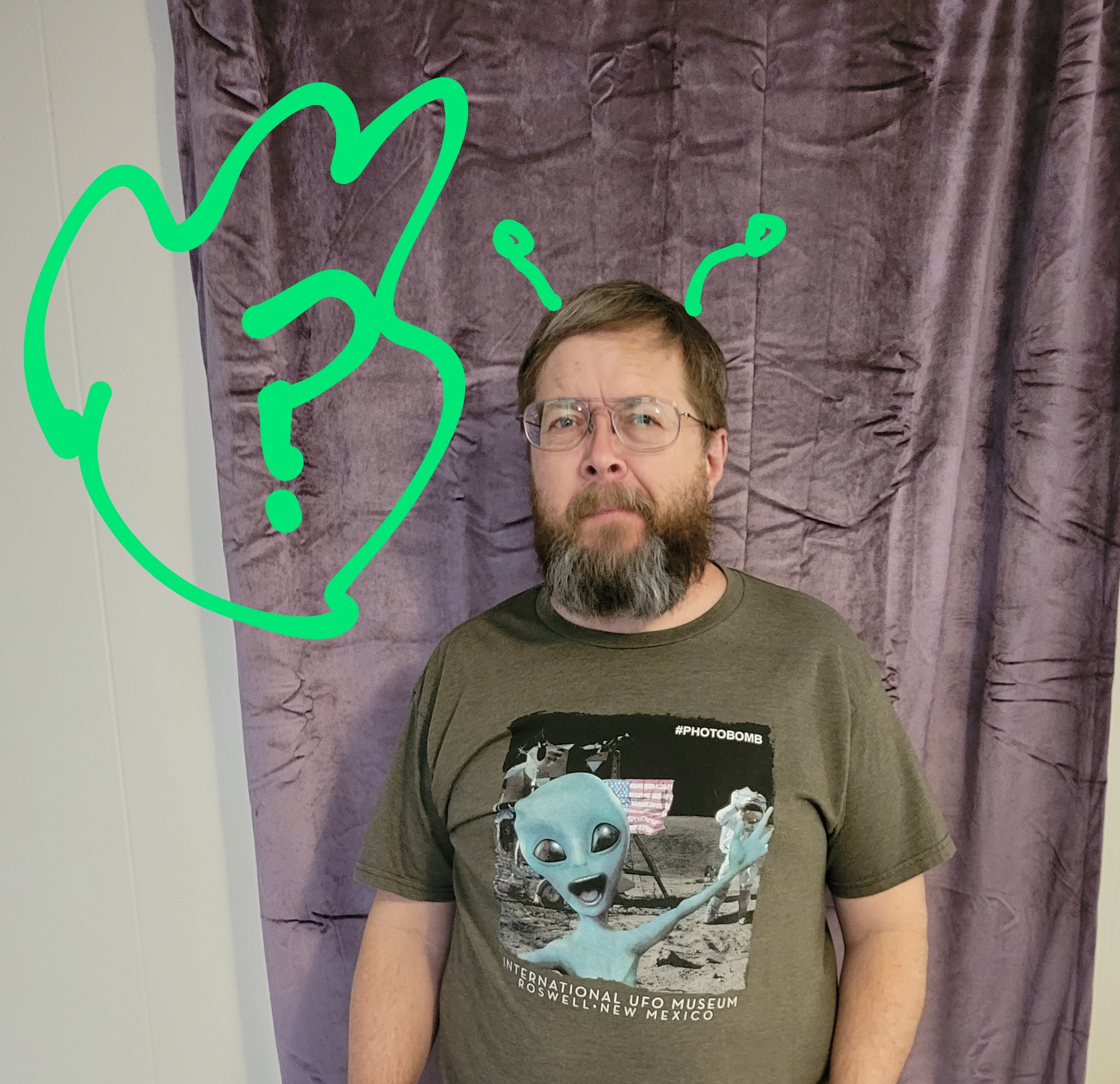
I am an alien. I don’t know how I got here. I arrived when a mousetrap snapped my 2-year-old finger.
Humans laughed at me. This made me very angry, but that’s when I became a human.
I don’t remember what I was before. But I knew my mission: learn how to be human.
Who the hell is this weirdo?
Sometimes I think I understand, I know what being human is, then I realize I don’t get it at all. Like I said, I’m an alien.
Joe Satriani – Surfing with the Alien
I report my findings often. I do it by thinking and words, as I did not arrive with a better method.
Many of my reports have been inaccurate and inconclusive, but I have found many clues. I update with corrections when I can.
Patti Smith – Birdland
This will be an open letter. Please cc the HR department.
To whom it may concern,
Humans have a practice called Yelling At Clouds. They yell by yelling and they yell by writing. They do it to complain about their mission. I believe they have the same mission as mine, but I could be wrong.
When they believe others are impeding their mission, they Yell at Clouds. Like me, they must not have a better way of contacting mission headquarters.
I am now Yelling at Clouds because I have struggled to complete the mission but have not received necessary support. Do I have to do all this by myself?
My complaints are as follows:
Impossible assignment: Learning to be human is exhausting and these units don’t function long enough to complete the mission!
No instructions: Humans give very different instructions when I ask how to be a human. I hope I’ve chosen the right ones, but their instructions keep changing! Who is handing out these assignments?!
No feedback: The mousetrap appears to have been a message from the team, but since then I’ve received nothing. My queries are never answered.
Your inbox must be overflowing with complaints, but I would like a response. I am committed to the mission.


 Late Boomer's Den
You must be logged in to post a comment.