Just discovered another amazing bit of culture from the Adrar region of Southern Algeria. I’d like to know more about this tradition. Looks fun as hell.
The polyrhythms with the clapping remind me somehow of Flamenco dancers in Spain. Hard to do. Looks like there’s a competitive element to the dancing.
I’m so overwhelmed, I don’t even know where to begin. I was going through YouTube, looking for interesting traditional music from around the world and discovered the arts and music of Karnataka, a state in the southwestern India.
Om Shakthi Jai Shakthi – Ravi Raj Karadi and team Beemsandra Tumkur. The video that first grabbed my attention. The costumed dancers are depicting the goddess Durga in her angered form, about to vanquish the evil lord Mahishāsura. This is part of the story of how the evil asuras Chunda and Munda were slain by the goddess Kali. (Thanks to a friend on Mastodon who filled me in.)
Some of it I loved right away. Some is so different from what I’m familiar with, I can’t tell yet. All of it fills me with awe. The variety of rituals, the complexity, the way everyone there seems to be involved.
I’ve never experienced anything like that kind of depth of culture. One thing in particular that blows me away is the theatrical art of Yakshagana. Through acting, singing, dancing and elaborate makeup, participants tell stories from history and religion.
Yakshagana – Bheeshma Vijaya 2
Vocal percussion tradition Konnakol is an art form I’m still trying to tune my ears to. One thing is for sure, this takes a TON of skill and training to pull off. Beyond impressed.
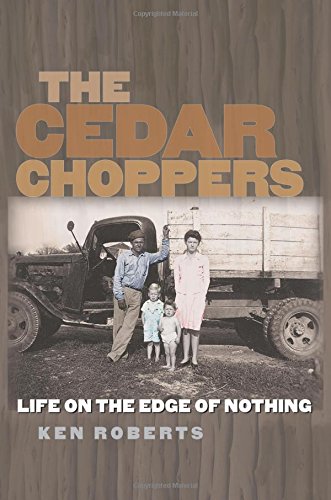
Ken Roberts, author of The Cedar Choppers: Life on the Edge of Nothing, talks about his encounter with a pair of Cedar Chopper kids on Bull Creek, when he realized there were people in Austin with a totally different culture.
I grew up in the Texas Hill Country in the ’70s and I want to talk about the Cedar Choppers. I’ve been reading a really interesting book about their history, The Cedar Choppers: Life on the Edge of Nothing, by Ken Roberts.
I’ve already learned some interesting things. Like for instance, you’d think with that drawl and being in the South, that the Cedar Choppers would’ve been all in for the Confederacy during the Civil War.
In fact, they were just as divided as everyone else. Roberts writes about an outfit headed by Dick Preece (1833-1906) that refused to fight for the Confederacy. “For two years they used the hollows and caves of Bull Creek to wage guerilla warfare against the Confederate home guard, calling themselves the Mountain Eagles.”
Not something I expected.
Hallie Mae Preece singing ballads for John and Alan Lomax in 1937. She was part of an old Cedar Chopper family from the Bull Creek area outside of Austin.
I recognize most of the last names in the book. I wasn’t a Cedar Chopper, but in a way they were my people. They were part of the mix, always around. I had some as friends. Grandpa, who was a medic in WWII, used to go into the hills when they had emergencies.
They’re the people who cut the cedar posts that fenced the West. Same people as in Appalachia, but at the end of the migration. They got to the limestone hills of the Edwards Plateau and never wanted to leave.
Until the economy made them.
Alexa Dee Crooks sings Little Blossom, a song that made it to Central Texas through Appalachia, all the way from the British Isles.Read her description under the video. Interesting stuff.
They provided wood and charcoal that powered Austin, Texas as it modernized. They made some of the best whiskey during Prohibition. They got to hunt and fish and live next to clear running streams. The Ashe Juniper kept them afloat during the Great Depression when so many others were going broke.
Gene Landrum – No Beer In Here, Cedar Chopper blues recorded in Boerne, Texas, in 1978.
Now their former territory has been nearly wiped out by urbanization. I get sad every time I drive in the outskirts of Austin and see the exclusive neighborhoods on Lake Travis, pretending to be “Tuscan.”
The people who live there think they have everything, but the Cedar Choppers were richer if you ask me. Eventually that rocky, almost worthless farmland, became “scenic” and worth a fortune and the Cedar Choppers had to move to town. Everyone lost.
An unnamed storyteller relates the tale of a loudmouth who made the unwise decision to pull a knife on a cedar chopper.
A lot of the reason I miss the Cedar Choppers is the very thing some people hated about ’em: how they could and would beat the ever lovin’ shit out of you if you disrespected them. I respect their cussedness.
Because people in town did disrespect them, a lot. And it wasn’t right.
They had the fiercest honor culture you ever heard of. If you were in the know, you didn’t fuck with them. Great friends, terrible enemies.
We had legends about them.
There was the one about the Cedar Chopper driving in the outskirts of Austin with a load of posts who decided to stop and let his kids buy Cokes. When the kids came out and said the man refused to serve them, he went in with a chainsaw and sawed the counter in half and said, “Now sell my kids a Coke.”
How do you not respect that?
They’ve owned the term at this point, but when I was a kid, calling someone a Cedar Chopper would get you in a fight. A lot of townies looked down on them, but if you were smart, you minded your manners.
Granny used to equate forgetting to comb your hair with “going out looking like a Cedar Chopper.” I think that was projection. She grew up a whole lot like a Cedar Chopper on the headwaters of the Guadalupe, and didn’t get treated very well when her family moved to town.
I actually owe my life to one Cedar Chopper neighbor who my mom said looked like she could whip a bear with a stick.
She caught me and my friends trying to crawl into a “cave” in front of her house where the ground had collapsed over the new sewer line. She saw what we were doing and said, “Oh no you ain’t!” and closed up the hole with a pickaxe.
We were so pissed. “Why doesn’t she mind her own business?” But that would have been the end of me. She also annoyed me and my siblings by making us share our candy with her kids. Different ideas about property it seems like. In the hills, squabbles over candy were probably a matter of cousin vs. cousin.
I also remember her park ranger husband shared a watermelon with me once on their front doorstep. I was just some kid on the street. They were different than us, but good people.
I have to talk about this guy: Farya Faraji. I really like his attitude.
He’s a singer, musician and a composer, but more than that, he’s an evangelist for culture. Persian music, Greek, Turkish, Balkan, Byzantine, lots more. They all get handled with skill and respect…
“My goal is to showcase musical traditions from all over the globe, regardless of culture, ethnicity and religion,” he says on his About page. “I want this channel to be like a musical world museum, a library of musical traditions from all over the world and all over time.”
I think he’s right. The world is hungry for this sort of thing. Real culture. Real roots. Everybody’s. Something that connects us to the parts of our culture the modern world threw away.
I like that he’s trying to give us a taste of the real thing, real culture and not the Hollywood corporatized version of culture. I approve. He’s already taught me a few things. I didn’t really understand just how Hollywood our concept of Greek music is.
I’ve always thought of Greece as Eastern, but not THAT Eastern. It has also caught me off guard, hearing Greek music that sounded Middle Eastern, but what he says makes sense. Cultures in close proximity to one another are going to have things in common. Greece is a lot closer to Persia than it is to England. What else would it sound like?
I hope his channel really takes off. I hope to see similar projects from other musicians. I’d say Peter Pringle is a good example, taking us WAY back, to the Mesopotamian cultures.
So many of us have forgotten how precious culture is. We’ve lost touch with the earth. We need to appreciate music that comes from the roots – our roots and everybody’s roots. Stop getting riled up over other generations’ wars and just enjoy the music.
I say this as an American Southerner who wishes he’d listened to his great uncle play the fiddle when he had the chance.
Still dipping into the Algerian music. Still having a hard time figuring out what kind of music Houda Hamouda was doing. – just that it was definitely not rai, the rock ‘n’ roll of Algeria and probably beyond.
With the control of Saleh-( a wonderful musical). Per Google Translate – best I can do.
Going back to one of the channels that posted some of her videos I keep finding other cool stuff. I found several jam sessions by this same group, The Nafis family I guess. Love the rhythms and that mix of tradition and new tech.
Karzika Bilal – (Tehivalt & Tabarlem) New. Per Google Translate. Just wait till those crazy beats kick in at around 1:50. I love the way Arabic looks, by the way: كرزيكة بيلال -(تهيڨالت & تبرلم) جديد
I may be wrong, but I think these guys are likely Berbers in the Red Oasis part of Algeria. I would love to be corrected if I’m wrong. I’m just an old country boy, figuring things out the best I can.
 Late Boomer's Den
You must be logged in to post a comment.