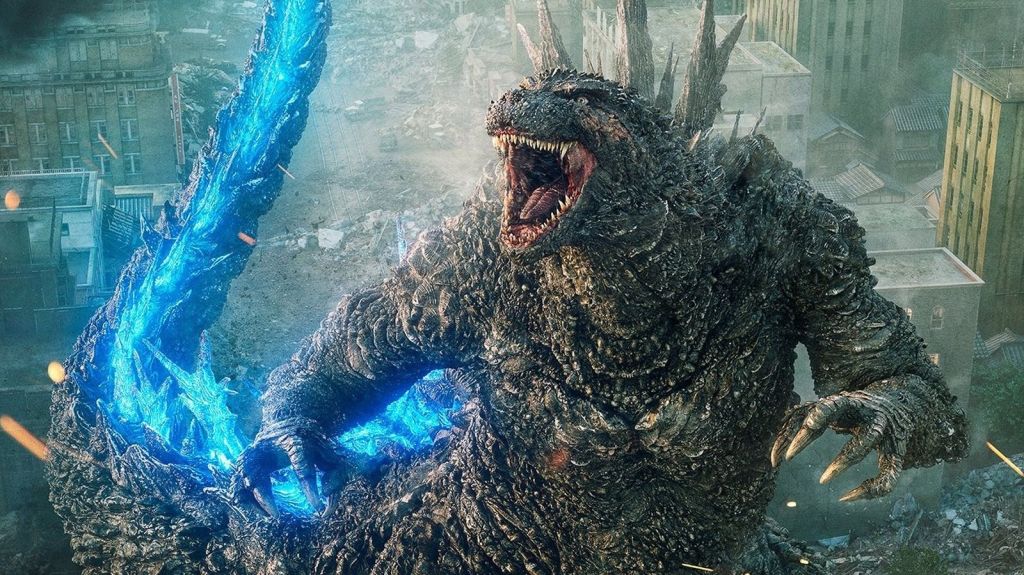
I loved Godzilla movies when I was a kid. I saw Godzilla vs. the Smog Monster (Godzilla vs. Hedora) in the theater. My brother was crazier about Japanese monster movies than I was. “Dear God, please don’t let a giant monster step on my house. Amen.”
Most of those movies were targeted at kids and were a lot of fun. As an adult, Godzilla movies have not impressed me. Until Godzilla Minus One. I didn’t expect to receive so much food for thought.
Setting the story in post-WWII Japan gave the movie an interesting dynamic. Especially since the main character was a failed kamikaze pilot. I cared about the characters and their predicament.
Instead of a disaster movie with a giant lizard, we got a man finding his purpose. Risking his life for his community, regular people dealing with an existential problem the “powers” were too preoccupied to take care of.
I’ve been told Godzilla represents the atomic bomb for Japan, but I think it goes deeper. I think it’s an expression of a hyperobject – something big and amorphous and impossible to ignore. Like global warming or the Cold War.
I’ve just begun reading Timothy Morton’s book about the concept, Hyperobjects: Philosophy and Ecology After the End of the World. I’ll get into it in this space once I’ve finished.
A while back I wrote that the movie Cloverfield is the best attempt I’ve seen to portray a distinctly American hyperobject – the imaginal monster that confronted us during 9-11.
I thought it might be interesting to compare the two hyperobjects based on some of my impressions from Godzilla Minus One. You could sum both imaginal monsters up as “powerful thing that might wipe us out,” but Godzilla has its own character.
Godzilla is Japan specific in a number of ways. For one thing, I feel like there’s an element of punishment. Shintoism has the concept of a Kami, a godlike entity that sends a tsunami when you’ve pissed it off.
Maybe throw in some resentment over how your cities got nuked thanks to the hubris of your leaders. getting nuked over the hubris of your leaders. And anxiety over being caught in the middle of an existential game of chicken.
I thought of that in the movie when the U.S. wasn’t available to help with the monster because it didn’t want to inflame the Russians. When monsters fight you’re bound to get trampled.
America’s “monster” a bit different in that there’s an element of Damocles’ sword. Having the power of a king means having a sword hanging overhead by a hair. America took on the role of a superpower and it still didn’t make us safe.
It isn’t just a king on a throne looking up nervously. It’s the whole country and in fact, the whole world.
Civilian populations are now bargaining chips. Because of us. Maybe it was called for at the time, but in any case, the bomb is one hell of a hot potato. And like the Japanese in Godzilla Minus One, we don’t really enjoy being put in this position.
There’s a sense of waiting for the other shoe to drop.
When I think of it, it’s all the same monster though it shows different faces to different cultures: the thing that shouldn’t exist, can’t be ignored and can’t be defeated.
“History shows again and again how nature points out the folly of man… Godzilla!” Blue Oyster Cult got it.
 Late Boomer's Den
You must be logged in to post a comment.