Foxy – Get Off. I got such a kick out of this video. I remember thinking this song was cool, back when I only heard music on Top 40 AM radio. Not sure what I would’ve thought if I had seen this as a teenager.
Seeing this over the top video of Get Off, by Foxy really took me back. I thought the song was cool when I heard it on the radio. What teenager wouldn’t? It’s about sex. But I definitely imagined them looking so much cooler.
I liked disco as a kid – until I didn’t. It was just one kind of pop music, like R&B or rock. Not that I thought of music in terms of genre back then. You just listened to the Top 40 station (KTSA) and you either liked it or you didn’t.
This is a little playlist I threw together of disco hits I remember liking. There were a lot more.The songs actually sound pretty good to me now.
I was a freshman in high school when I saw a long-haired rock ‘n’ roll dude in a “Disco Sucks” T-shirt. I remember thinking “Somebody had to say it.” I didn’t hate disco exactly. I just realized I was really really tired of it. The fact that I’d just discovered album rock played a big part also.
I didn’t yet know about the “Disco Demolition” incident in Chicago where they blew a bunch of disco records at a Chicago White Sox game and caused a riot. But I wouldn’t have been surprised.
I understand a lot of people put the anti-disco backlash down to racism and homophobia. That was probably part of it. My friend’s dad had some choice nicknames for disco. I’m sure there was a lot of heartburn over the Village People getting as popular as they were.
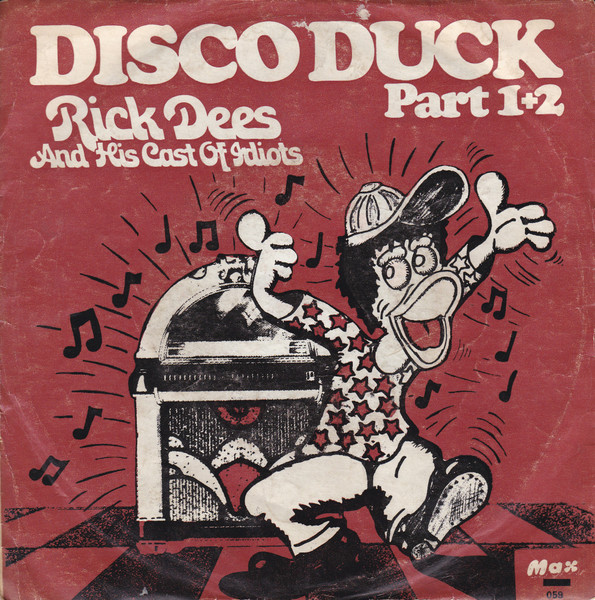
I liked Disco Duck by DJ Rick Dees – when I was 12.I don’t really want to hear it again.
But mainly I think it was over-saturation. The market did what the market does: took something popular, tried to squeeze out every penny, and ran it into the ground. It was in movies, TV, advertisement jingles. There had to be a disco version of everything, from classical music to jazz.
And you couldn’t escape the Bee Gees, who frankly were too good for their own good. If they weren’t on the radio or TV, they were producing somebody else’s song and singing backup. After a while enough was enough.
It’s been long enough now that I can listen to disco again and enjoy it. Even the Bee Gees. I also like that younger generations don’t have those prejudices against different types of music. Disco is as legit as anything else.
I stood on a hill with many others, excited and terrified. The Rapture was upon us. Those found worthy would ascend to heaven. The rest would be left behind on a doomed earth.
The Rapture would take place inside a building in the valley below. I don’t remember what it looked like on the outside, but inside, it looked modern. Businesslike. I tried to put aside my doubts.
A loudspeaker directed us to a row of turnstiles, where you would learn if your name had been written in the Book of Life, or if you would be left behind to burn.
My name was called.
I was so relieved I didn’t think to ask questions. Like why was I not flying to meet Jesus in the air, like I’d been taught to expect? Why did God need technology, turnstiles, or loudspeakers?
The next part was jumbled. I was on my way to heaven when I realized I was lost in a maze. Then I had a monotonous job operating machines, then another, then another. Heaven never followed. I had to escape.
I’d been fooled. This was some kind of trap. A trap full of traps.
I don’t know how, but I found my way out. Only to find that everything was gone, charred, replaced by rubble, charcoal and ash. It looked like the aftermath of Hiroshima.
There was no Rapture. The building was a machine. Wealthy men built it to destroy the world, using our faith and labor. The machine was meant to eliminate the population so they could start from scratch. We had helped bring about the Apocalypse we sought to escape.
Last thing I remember I was wandering through rubble, feeling dejected and used. Feeling like a fool.
U2 – Until the End of the World
What it meant
That dream has haunted me for half my life. What was the Rapture Machine? I’ve spent the last 30-plus years trying to figure that out.
It took a long time, but I understand what the dream was telling me: The religion I knew, the one that taught me my values, had been seduced and hijacked.
The Rapture Machine promises a materialistic version of Heaven. You don’t have to die to get there, just be willing to sacrifice others or look the other way.
The Machine makes it easier by distributing the sacrifices widely. No one may opt out. They can only be cast out. How could any kind of spirituality survive that?
The Religious Right had turned Christianity into a doorway to The Machine.
I had that dream in the late 80s, when I was still trying to be a Christian, though I was souring on the Baptist church.
Churches I attended in college only seemed to care about the offering plate. One church started every service with, “The Bible Teaches it, God Commands it: Tithing.” As a college student with no job and no money, that left a bad taste in my mouth.
I went to Baptist Student Union events, hoping to make friends and meet girls, but ended up feeling lonelier than ever.
I couldn’t discuss my doubts with anyone. “Read your Bible and ask the Holy Spirit” was the signal to quit asking questions.
Meanwhile the influence of the televangelists, of Prosperity Gospel, was overwhelming the version of Christianity I learned in my little unadorned Baptist church, with its old farmers, teachers and other small town folks.
Poor Man’s Poison – Give and Take
It’s not just a Christian thing
What does the Rapture symbolize? Escape. Everyone is born in a vessel that must toil, suffer, fear and die. For Christians who believe in the Rapture as I once did, it’s a promise of heaven, the antithesis of suffering.
It isn’t just a Christian motivation. It’s universal. If you find yourself in a trap, you want to escape. Unfortunately, life is full of traps. Escape from one trap inevitably leads to another.
Promise of a better life is strong motivation, no matter your religion or lack thereof. Modern life, with conveniences our forefathers never dreamed of, will tempt anyone who wants to survive.
The Machine
The Industrial Revolution gave birth to the monster we refer to as the Machine. Or maybe it’s been with us since the dawn of civilization itself and modern machinery just raised it to adulthood.
I don’t know if it’s sentient (yet), but the Machine has a purpose: Never stop growing.
Now, with advanced AI threatening everybody’s livelihoods, it seems we’ve decided to make The Machine smarter than we are, when most of us already serve it without knowing. Feels like my old dream coming true.
The ultra-wealthy only think they control it, but they’re in a trap just like the rest of us. The more they have, the more they feel like targets. They grow their castles to keep out the poor and before you know it, they’ve built their own prisons.
The rest of are kept in The Machine by promises of heaven or wealth. Someday, always someday. False promises are the carrot, Poverty is the stick. Miserable, degrading poverty.
Premonitions and Predictions
Was my dream a premonition? Did my dream predict the future? Almost certainly not. My head was stuffed full of science fiction and literature as well as religion. My unconscious made an educated guess.
I think the unconscious part of us, the part we mostly deny in the “rational” West, can solve problems and draw conclusions based on fewer clues than our conscious minds. The problem is, the unconscious communicates through symbolism we cannot easily understand consciously.
Just read about Craig Robertson, the 70-something man in Utah who got killed by the FBI as they were serving a warrant. Based on his social media content where he threatened to assassinate Biden and other officials, it looks like the FBI did what it had to do.
On one level, he got what he deserved. He asked for it and he got it. But I got to thinking, what would this man be like today if America hadn’t made this lurch to the right?
Would he have been bragging about his sniper rifles and Ghillie suit. I imagine he’d be your basic, slightly racist grandpa. Maybe not the greatest guy, but fewer guns and a good Santa for the grandkids.
Or maybe I’m wrong and he just was what he was. Who knows.
It got me thinking about how shitty it is that a sophisticated propaganda machine decided to weaponize people like that guy. Most old men, even those with a shit ton of guns, would never do something like that.
But a lot of them have gone far enough right to alienate their children and grandchildren. Which is a tragedy in itself.
Why am I lucky? Because I was born right in that generational sweet spot. Too young to get hooked on Fox News, too old to get sucked into the Manosphere on social media. Aloof enough to avoid parasocial attachments to my favorite entertainers who decided to catch the wave of crazy, for the money or the crazy.
Old enough to remember Walter Cronkite and actual journalism. Young enough to enjoy the Internet, when it was a place to open minds rather than close them. Old enough to get a college education, while that was still in reach.
Lucky I had the teachers I had, read the books I read, had the parents I had. Lucky I was able to tell the Republican party was a runaway train and jump off early enough so I can sleep at night.
When I was 12 years old my dad bought me a microscope. Nothing fancy, but solid. I spent hours at a time with my eyeball glued to that thing. I kept a Mason jar full of water from the nearby stock tank or the mud puddle in the driveway.
I looked at all the obvious things first. Salt, sugar, leaves. But nothing was better than a dropful of muddy water. So many little dramas going on that we can’t even see.
What must it be like? One second you’re munching on a protazoan or a blob of algae and next thing you know, you’ve been sucked down some rotifer’s gullet. None of them know about fish, or people, or air, or the stars. Not much thought going on down there, just pure survival.
And the poor things are so tiny they can’t even tell they’re on borrowed time. They’re battling it out in a drop of water and they’re all going to die when it dries up.
I’ve thought about getting a new microscope for years, but it’s a lot easier to watch YouTube videos. Besides, my interests have broadened. I always wanted to be an inventor, for example. Unfortunately, I am the opposite of technical.
But I didn’t give up. A while back I started getting into mysticism and psychology, read a bunch of philosophy books bought a couple of Tarot decks and I invented something: a psychroscope.
It took a long time to come together and it’s still not perfect, but I’m seeing more all the time. It’s like a microscope, but pointed outward, toward the psychic medium. And what did I see?
Same thing I saw in those drops of pond water. Life. Creatures of thought, Unaware of what they are or where they’re going, swimming through unspoken thoughts and little kids’ dreams. Narratives nested inside nested narratives, meta meta meta narratives.
Entities that live both inside and outside of us. Gods or monsters we all create together. Moving images we project onto the world, filtered through our fears and desires. Are they real? Depends on how you define real. If enough people think they are and act accordingly, they might as well be real.
I think they’re a bit like the cosmic horrors Lovecraft wrote about. You might call them “Elder Gods” but they’re not older than us. We made them. They’ve grown up with us. Whether they are evil or benign depends on us.
Kristen Schaal is a Horse gag. I originally included the one from the RadioLab episode, but the user privated it. The one I saw in her special was wayyyy longer.
Ever get so high you get caught in a loop? You just keep reliving the same moment, over and over. At some point you realize that’s happening and you start trying to escape it.
If you can just do or say one thing different this time, it’ll stop and time will move forward again. But still you get to hear, “You already said that” a million times. Feels like forever, but eventually you sober up and break out of the loop.
I am fascinated by the fact that the human minds can do that. I remember listening to a Radio Lab episode about that years ago. The one where they talk about the Kristen Schaal is a horse gag.
Radio Lab referred to these as fugue states. Sometimes it’s a permanent condition, one I hope I hever have. It’s such a strange concept, because short term amnesia, that I get. Your brain doesn’t encode the new experience, so you can’t remember it. That makes sense.
But… so you just live that moment forward again. Why do it the same way? Why say the same things? That part’s crazy to me. Like you were destined to do those things. That idea is unnerving. To what extent are we a computer running software?
My current theory of what happens is your brain probably tried to divide by zero. Or the language equivalent.
We’re already living out loops anyway, they just happen to be longer than 15 minutes. Don’t you get in ruts? Don’t you find yourself telling your wife the same stories you’ve told her a hundred times?
I don’t know about you, but it kinda bothers me to feel like I’m just a set of code. That was destined to do things a certain way because of that code and I have no say in it. I think that’s why I’ve always been a contrarian and tried to experience things that will force me to change.
I think that says something about time travel stories that have loops. As common as the fantasy is of going back to fix the past, you know it doesn’t make sense. So you’re not surprised when efforts to change things don’t work in the plot and the same mess comes around again. You’re technically still breaking physical laws, but nature corrects itself.
Still, we really want to believe. That’s why time travel stories that do break out of that loop and change things are more uplifting than ones where there’s nothing they can do.
The idea of getting stuck in an intricate loop for eternity is a pretty horrifying concept. It’s not a spoiler to say Predestination is a good example of that. The name gives it away. I still get chills thinking about that “ending.”
Mark Twain said “History may not repeat but it sure does rhyme” and I agree. But rhyme is at least a slight improvement over repeat.
I thought this was an interesting interview. I knew what she was going to say and I what the comments would be like.
It got me thinking about language and how we use it to rank each other, sometimes without knowing it. Dialects are judged to be “low” or ignorant. As informal writing proliferates, the same thing happens with written language.
Elitists and old people are like, “No! Stop! You’re doing it wrong!”
I have a BA in English, so I learned a lot about the rules, how English “supposed” to be.
But I took one Linguistics class in college and that changed everything. I learned how languages change and evolve. And I learned something my grammar nazi mother absolutely hated: Rules follow usage.
When enough people do it, it’s the new rule. I also love language. I like playing with slang & doing it wrong on purpose if it works. Gen Z is treating language exactly as you should expect. Adapting it to their environment.
It reminded me of the NBC video clip I saw a while back about Gen Z doing away with the period. I had the same knee jerk reaction as a lot of people: Damn kids, learn how to write! But after watching the video I’ll be damned if it didn’t end up making sense. It’s texting. I don’t end texts with periods half the time.
It’s adaptive. They’re learning how to make a notoriously unexpressive media convey emotion.
I love language. I love the way you can mold it and shape it. I love how it adapts. I only know a little Spanish, enough to read signs and packages, but if I could go back in time, I’d learn a dozen languages. I bet I was a linguist in one of my alternate dimensional lives. I wonder how many I learned.
Language is almost metaphysically important if you think about it. The language you speak determines what you can even think about, what you think is real or possible. How mindblowing is that?
I’ve been thinking back on the “edgy online atheism” phase I went through in the early ’00s and why I quit doing it. Not that I became religious again, but spiritual isn’t a dirty word for me anymore.
In fact, some form of spirituality could be very healthy.
The angry phase lasted for a few years after I completely lost my religion. I had already abandoned my cognitively dissonant fundamentalism and was hanging onto the idea that God had a plan and I was in it.
Then life circumstances walloped me upside the head and made that impossible. Sometimes a tragedy is just a tragedy and no “mysterious ways” argument can ever justify it. Disasters happen because the world and the universe have no morals.
So I went hard on the atheism. I spent way too much time virtue signaling to other atheists online. I got into people like Richard Dawkins and Matt Dillahunty.
Whatever you think of him, Dawkins deserves a lot of credit for coining the term “meme”, long before anyone ever made one online. Funny how memes as we think of them now illustrated his point about the replication and evolution of ideas.
Back then I had that edgy online thing going. I thought I was so smart. I had figured it all out (again). I was in my 30s, too old for that kind of attitude. But I realize now I was just angry. Not “angry at God.” Angry because I’d been lied to.
Angry because I was grieving.
It’s a phase you have to go through when your worldview gets yanked out from under you. Pissed off and betrayed. You want everyone to know what horseshit it all was.
But ultimately the fire burned itself out. I support and agree with atheists most of the time, but that can’t be my tribe. I needed to move on. Atheist felt like a description, not an identity.
That’s all it really was. Grief.
You probably know about DABDA, the stages of grief. Denial, Anger, Bargaining, Depression and Acceptance. You don’t always go through it in order, but I went through all of that when I left Christianity.
If you can make it to the last stage of grief – Acceptance, you can maybe acknowledge it wasn’t all horseshit. You probably got something of value out of it or you wouldn’t have grieved over it. That’s where I am now. I don’t believe it, but I’m not angry. If anything I’m sad.
It occurs to me that grief could also explain why Christians seem to be angry these days. Why get so angry when others won’t believe what you do? Why do you wish so hard that they would just STFU?
Could be because they’re in the first stages of grief: Denial. Deep down, maybe it’s not as meaningful as it used to be. They’ve got some causes and some firebrand preachers to whip them into a frenzy, but maybe it’s not enough.
Folks who weren’t raised religious might not understand, but having your world view ripped out from under you is a terrifying prospect. Even if you know deep down it’s something you have to face if you want the truth.
I’m beginning to understand that science and rationality, while important, are not enough to hold a society together. Westerners – Americans in particular, are suffering from a lack of meaning and it shows.
I’ve been afraid to read Nietzsche because of his fans (adding him to the list), but now I understand what he was trying to warn us about. Christianity was the glue holding Western Civilization together.
I’m never going to back, but I no longer want Christianity to disappear. After all it’s where I got my values. I want it to change, into something that plays well with others and still provides a sense of meaning and community.
Perhaps go look at some of the early Christian sects, when the influence of Neoplatonism was stronger, see what might have been discarded that could be brought back.
Lately I’ve been a big fan of Canadian cognitive scientist and philosopher John Vervaeke. He’s been talking to a variety of thinkers in various fields. He hasn’t disappointed me yet.
He published a 50-episode YouTube series, “Awakening from the Meaning Crisis” where he goes through the psychological developments that underpin Western Civilization. I’ve already learned a great deal. Not even halfway through yet, but I’ll get there.
He also has some interesting and frankly ominous things to say about Artificial Intelligence and the massive ways it could impact our society.
I had forgotten, but this video jogged my memory. Interesting story collection that I might read again soon.
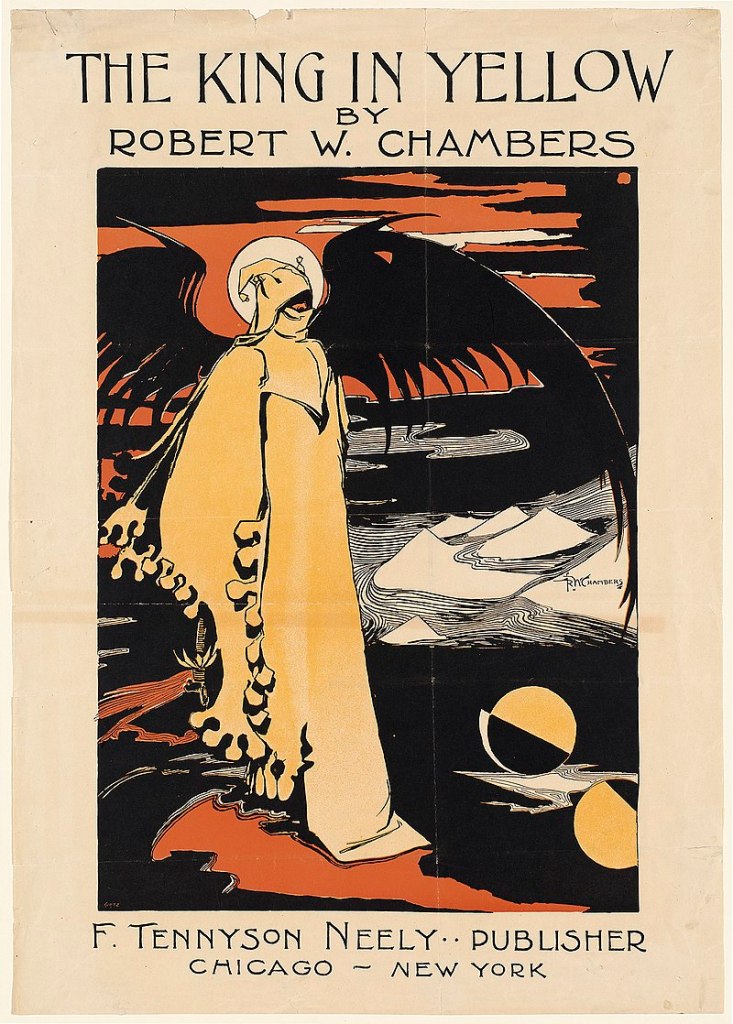
I first came across the name, The King in Yellow, in the Blue Oyster Cult song, “ETI,” just a brief reference: “The King in Yellow, the Queen in Red…” But I loved BOC and always wondered what all their symbolism referred to. Who was The King in Yellow?
Sometime in the ’90s, I decided to find out. I read The King in Yellow, a short story collection by Robert Chambers that refers to a play of the same name that drives everyone mad who reads it. Like a mind virus.
I thought it was a pretty cool conceit. I wonder if it might have inspired Infinite Jest, David Foster Wallace’s novel about a video so addictive people rewatch over and over until they die.
When I opened The King in Yellow, I couldn’t help thinking, “what if?” Same delicious forbidden fruit feeling I got when I listened to heavy metal as a religious teenager. I didn’t think it was devil music, but it still felt like I was taking a risk.
Blue Oyster Cult – E.T.I.
I remember “Repairer of Reputations” in particular, where Hildred reads the play while recovering from a head injury and becomes convinced the spread of the play has prepared the American people to reestablish Lost Carcosa and make him king. Like something was manifesting into reality.
I’ve had that feeling before, like if you just knew how, you could pull some of that dream stuff out into the world and make it real. I think of it as “the dragon’s whisker.” I know you really can’t. But it FEELS like it.
The play in The King In Yellow used to just seem like an interesting device. No way reading a creative work is going to make you crazy and mistake fantasy for reality.
Then it occurred to me. The Internet does that all the time.
In one way, the Internet is exactly like Infinite Jest, so addictive you can’t stop looking at it, even as your life falls apart. But perhaps the King in Yellow is an emerging inhabitant of the Internet, trying to be born.
He lures you in with that first act, then breaks your mind in the second act, tells you how important you are, has you pining over imaginary empires and your place in them.
That was just stoner brain talking, but now I’m kinda spooking myself.
I’ve decided what I think makes the Netflix Show Travelers so interesting. It’s a time travel story, but really it’s a story about the ethics of human sacrifice.
The fact that the time travelers arrive in the 21st century by taking over other people’s minds, sets the tone right away.
They take the high road by (mostly) taking the minds of people who are about to die, but that’s a rather weak justification.
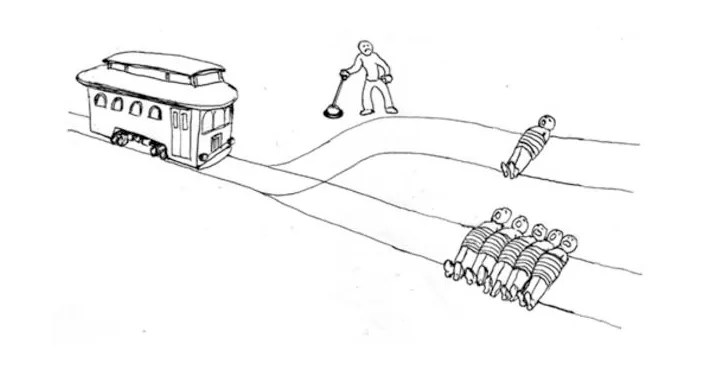
They area clearly trying to do the right thing, but they are still playing a hardcore game of Trolley Car Problem.
You know, the dilemma where one person is tied to one track, five people to another. You can throw a switch and kill one or do nothing and five will die. Which is the moral choice?
Travelers raises the stakes even higher. Which and how many individuals must be sacrificed in the past to save humanity in the future?
We make similar decisions in the real world. We can’t know the future, so there’s no way to justify the sacrifices of others that our society makes for supposedly greater cause. But we sure try don’t we?
The Director is in a better position than we are. It can know the future, sort of. But because it exists in multiple timelines, it can’t base its decisions on certainty, only probability. It’s very smart and it means well. But it makes mistakes, so do its operatives.
There’s no way to “win” the trolley problem. You have to make a bad choice. But you know the main characters are the good guys – because they’re the main characters.
Just like all of us. The stakes might not be as high as they are in Travelers, but everyone gets into damned if you do, damned if you don’t situations.
We also know when we didn’t really have to make that bad choice… But we know we’re the good guys – because we’re the main characters.
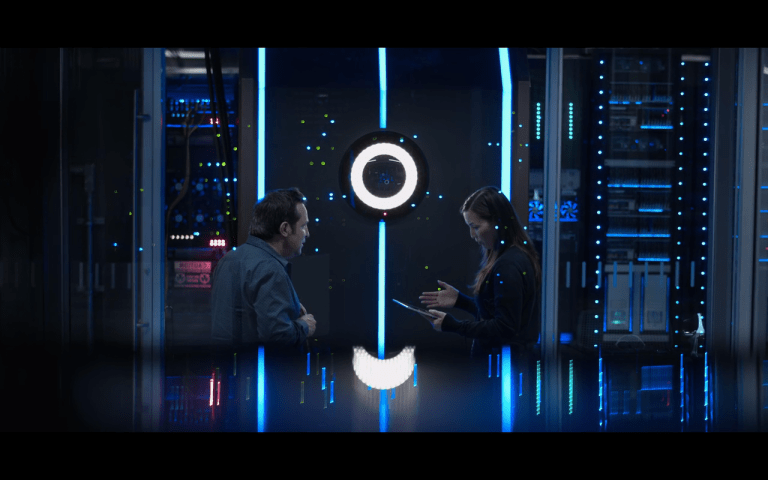
Waiting for the Director entity to arrive inside Ilsa, a 21st century super computer.
Netflix’s Travelers is a real head trip. It’s like a brutal version of Doctor Who, trying to “fix the timeline” where the Doctor is an artificial superintelligence with human special ops.
There are so many heavy topics I could get into with this show, but the one that just really hit me was the idea that you could have a relationship with an AI.
What would that be like? It could be like a grandparent who’s stuck around for a thousand years. You could get attached. Or it might come across like a boss, or a general, or maybe a prophet.
The main characters talk about it with respect and awe. I also get a sense that the entity also feels attached. To both humanity and to favored individuals.
I don’t know if machine consciousness is possible, but let’s just pretend that it is. What would it be like having a relationship with a superintelligence?
Imagine the awe you would feel. Because benign or evil, it would have power over you and you would be well aware of it.
It could outthink you. It could access more information in a second than you could learn in 100 lifetimes. It could compute an unimaginable number of probabilities.
In that scenario, you’re not talking to an individual, you’re talking to a POWER. It would be a bit like talking to a god, an angel, or perhaps a genie.
Frightening, but that’s also the best case scenario, imo, the one where you can have a relationship with the machine and it doesn’t just decide turn every atom it can into more of itself.
In the show, the Director seems to have a paternalistic relationship with the human race. I don’t like the idea of giving it that much power over us, losing that much free will. There is an insurgency in the future that feels similarly.
But there are worse ways it could go. It could be a master-slave relationship. Talking to a machine like that might be like dealing with a dictator or a mafia don.
Or we could just be tools, being told where we need to go to keep the machine running. No more a relationship than we have with our cells. Even worse, we could be seen as raw materials, or just in the way.
There’s no way to predict how all this will go, but we might as well start thinking about it.
What should Humanity as a whole, do if something like that arises? If we can’t stop it and can’t turn it off and they can outthink us and command every resource of the planet, we will have no choice. We will have to petition for a relationship.

 Late Boomer's Den
You must be logged in to post a comment.