I’m one of those annoying people who always says the book was better than the movie, but sometimes I cheat and watch the movie if I want to get cultured without reading the book. That way I can at least talk about it if it comes up and pretend like I know something.
Otherwise it goes to the back of my reading list, which is a lot like the back of my refrigerator right now. Not sure what’s back there at this point or if it’s any good. I don’t have a theater list.
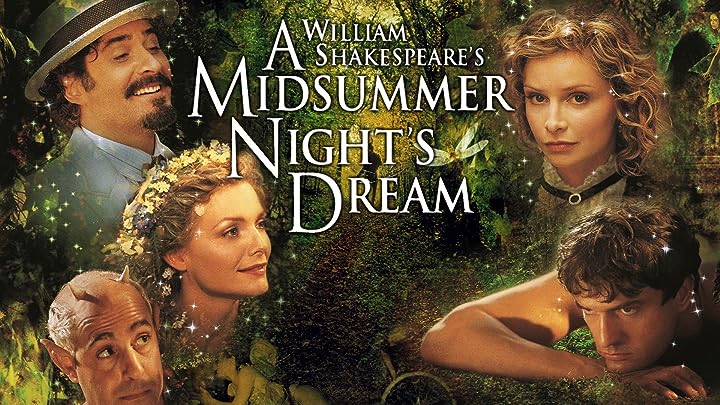
So I was talking to my wife about how Shakespeare had some good dirty jokes back in the day but got away with it because he spoke posh. And we decided to watch A Midsummer Night’s Dream, which she saw in a theater and I didn’t.
The one with the currently famous actors.
I wanted to watch the actual play, so I don’t make a fool out of myself by talking about how people in Romeo and Juliet’s day called their guns swords. Then I realize it’s set in the 1800s and I start getting paranoid they were gonna go all Baz Luhrmann on us and make me lose English major cred.
But they were talking Elizabethan English so I figured it was OK.
Poor young lovers getting jerked around by those meddling fairies. It reminded me of when I used to play Doctor Jekyll and Mr. Hyde with the dog when I was a kid. It really freaked him out.
So anyway, I think I did a culture, but they have that wacky play at the end with Kevin Kline’s character. Was that stuff in the play or did they Hollywood it up? Made me suspicious. It was too entertaining.
I’m the one who wanted to watch Shakespeare for the jokes. Was he really that funny?
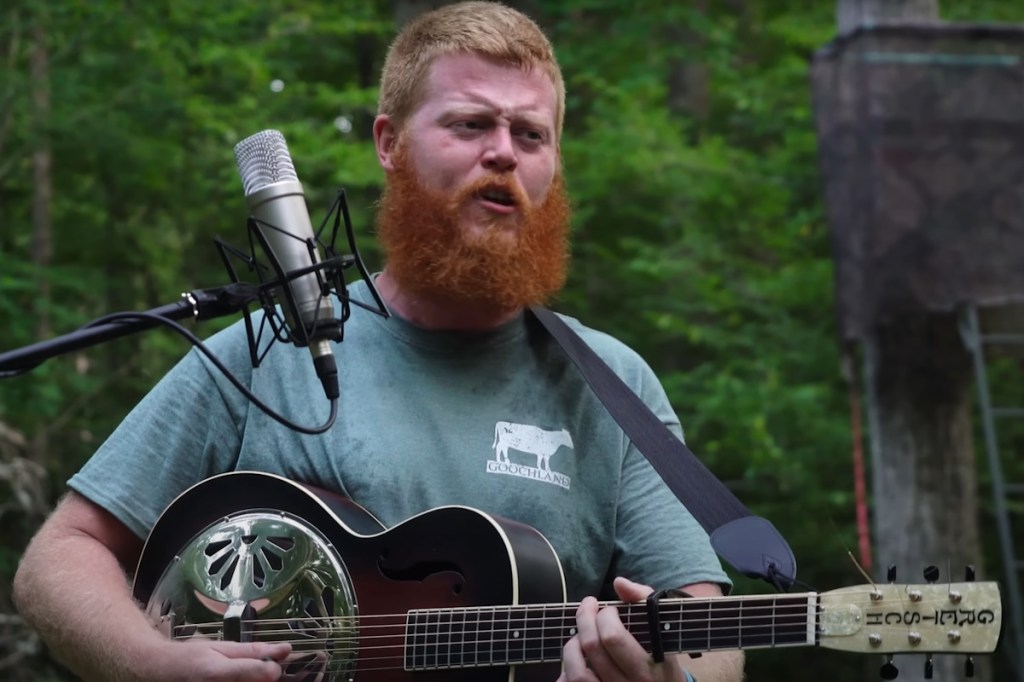
The internet squabble over Oliver Anthony’s song “Rich Men North of Richmond” really got under my skin. I already wrote about him, but I wasn’t done. I couldn’t write about anything else until I got it out of my system.
I’ve always been a contrarian. Sometimes I stick up for the wrong people and get egg on my face. Maybe it’ll happen again. But I’d rather be a contrarian for undeserved empathy than undeserved cruelty. I hate having to choose between mobs.
“I Want to Go Home” really gets me in the feels, with that line about the grandkid selling the family farm and seeing “only got concrete growin’ around.” People in the country do get attached to the land. The system doesn’t like that.
Instead of dwelling on what Oliver Anthony’s agenda was, I decided to take a deeper dive and see what I thought of him as a musician. I’m a fan of his type of music. Based on the dozen or so very good song he’s been uploading for the past three years, I don’t see an agenda. As far as I can tell he’s just been following the muse and got caught up in other peoples’ fight.
This comment on his Facebook page doesn’t sound something a would-be culture warrior would say: “I HATE the way the Internet has divided all of us. The Internet is a parasite, that infects the minds of humans and has their way with them. Hours wasted, goals forgotten, loved ones sitting in houses with each other distracted all day by technology made by the hands of other poor souls in sweat shops in a foreign land.”
I can’t help but notice he’s Appalachian. A culture that has influenced a lot of America, but doesn’t seem to get much respect. There are reasons why he and his fans think the way they do.
She talks about exploitation by the timber, mining and pharmaceutical industries.
What I found interesting was her explanation of how money-based economies and governments try to urge people from land-based cultures into the city, and how that has resulted in a superiority complex among city dwellers and internalized shame among country folk.
Oliver Anthony – Rich Man’s Gold. I like the tone of this song. “You weren’t born to just pay bills and die…”
As for those lines about welfare… I watched his Joe Rogan interview and he said something interesting about “Rich Men North of Richmond.” He didn’t think it was his best song and was only half-finished when Radio WV chose it. He finished the second half in a hurry.
So I think he meant what he said, though not necessarily with any ill intent. It’s pretty much middle of the road thinking where he lives. I had similar views as a rural Texan, and I was a lot more liberal than the average Republican.
Why don’t people from Oliver Anthony’s demographic find progressives convincing?
It comes down to something Kingsolver said. “We will only take information from people we trust…. so if you open a conversation with ‘you bonehead’ the conversation is over.” In other words, they don’t trust the the messenger, so they don’t trust the message.
City culture is the mainstream culture of America. Most of our media comes from cities. But that’s not the only culture. People in the countryside don’t feel like city people aren’t on their side.
So they don’t trust what the mainstream says. That’s how the rich men north and south of Richmond are able to fool them. They pretend to care. If those rich men won’t lift a finger to help, at least they’re on the correct “side.”
What would it look like if progressives actually did care?
In the South, there is a custom where you want to have a little conversation first, before you get down to business. You talk about your kids, your dogs, your favorite music. Anything to establish a connection. I think that custom would come in very handy on social media.
If you dislike the messaging in “Rich Men North of Richmond,” and you find someone who likes it, what if you tried to make a connection instead of writing them off? You liked his voice, or maybe you like some of his other songs? Start there and maybe they’ll care what else you have to say.
Oliver Anthony – Ain’t Got a Dollar. I can vibe with this song. There is value in living on the land near where you grew up, instead of moving all over to chase a dollar.
Writer’s blocked at the moment. I’ve been writing, but it’s all been dreck. Spent two days working on something and decided I was talking out of my ass. Decided to chill for a bit and listen to one of my favorite bands: Suede, aka the London Suede.
So unique and beautiful. I don’t know why they never made it big in America. Currently watching this awesome live concert video, Love & Poison, recorded at the Brixton Academy in 1993. I can’t think of any band that sounds quite like they did.
I especially love their debut with its beautiful ballads like “The Next Life” and “Pantomime Horse.” Those get me every time. I need to go back and listen to their whole catalog for that matter.
BTW, they have links to a bunch of other live concert videos in the description.
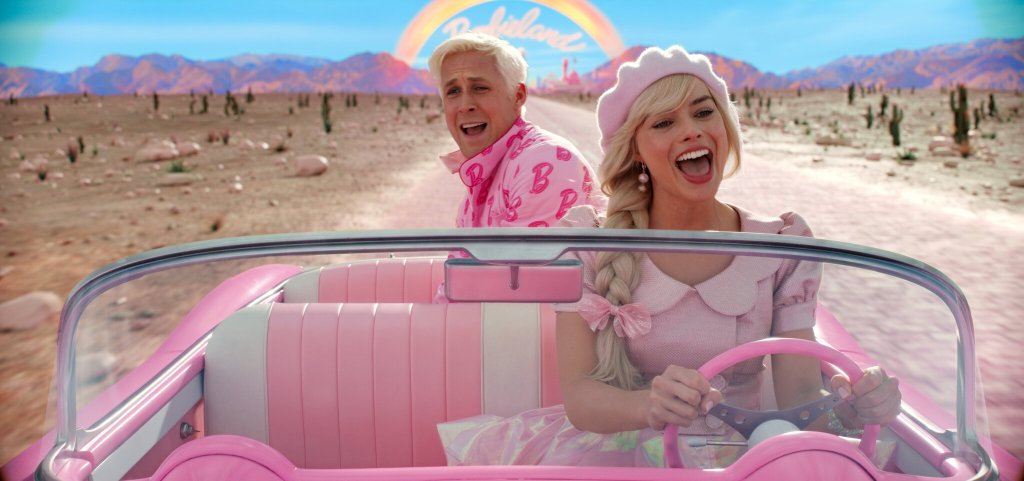
I missed out on the whole Barbenheimer experience when everyone was so psyched about it, but I finally saw Barbie. I wanted to see what all the fuss was about. (Really liked Oppenheimer as well, for different reasons. Don’t make me pick.)
I thought it was very witty, a good piece of art. I’m surprised Mattel let Greta Gerwig make so much fun at their expense. Pregnant Barbie? A Barbie with a TV in her back? A dog that poops candy? All those ridiculous dolls really existed… What were they thinking?
I didn’t feel particularly attacked. The fact that nobody ever played with Ken has been a running joke for as long as I can remember. It was obviously targeted at women who have grown up and are realizing society has rules it expects you to follow. They are often unwritten and contradictory. It can leave you paralyzed just trying to be yourself.
I think you could almost flip it around and make it about men, except there isn’t a comparable toy for us. I had a GI Joe and my brother had an Action Jackson when we were kids, but neither of us cared much about them. We were mostly out playing in the mud.
As any guy who’s not getting any will tell you, it’s pretty damn difficult to be a man also. You have traditional roles (aka “peer pressure from dead people.”) and modern roles. Also contradictory and hard to live up to.
I’d sum it up by saying it’s damn hard to be a human being in general. But it’s life, it’s real. When Barbie had a chance, she picked life. Messy, difficult, exciting, real, and a lot more rewarding than the version where everything is predictable and perfect.
A few days ago I noticed the YouTube reaction channels talking about this red-haired country singer, Oliver Anthony. Just a guy and his guitar, singing his heart out. I was moved as a lot of the reactors were moved.
Oliver Anthony – Rich Men North of Richmond
Then a few days go by and suddenly my feed is swamped with “reactions” by some of the worst people on the Internet.
It seems the right wing had snatched him up as one of their own and were using him to sow division.
Sounds genuine to me. Hoping for the best.
Then the left wing creators started giving their takes. He’s punching down on welfare recipients, he might be anti-Semitic, he’s an industry plant, etc. So I second-guessed myself.
I thought great, something else to fight over. I finally see someone who seems like they might be able to get Americans talking again – and wham! They’re fucked right out of the gate.
Oliver Anthony – Ain’t Gotta Dollar. I like this one. Puts me in mind of bluesmen like Robert Johnson and Mance Lipscomb.
But there was something about that song. It felt genuine. We’re not used to genuine these days. Go for the cynical take straightaway and you don’t get disappointed. But maybe he was the real deal after all?
Sure enough, he popped up with a clarification. He didn’t much appreciate getting “adopted” by the Republican party and having his lyrics misconstrued. His line about welfare might have come across like a right wing talking point, but I don’t think he meant it that way.
He comes across to me as an independent country conservative, basically me, 30 years ago. I had a heart for the poor back then, but I might’ve said similar things about welfare. I just wasn’t able to see the big picture back then.
I see where he turned down a record deal by some folks who apparently wanted to promote him as something he was not. So maybe he’ll do the YouTube thing like Ren and make it that way. Integrity? Could it be?
Billy Bragg – Rich Men Earning North of a Million. I never grew up around unions. Texas is a “right to work” state. But this country needs unions. The world needs unions. I’ve never been as sure of that as I am now.
I did kinda like the way English activist and folks singer Billy Bragg handled it, putting out a pro-union version, “Rich Men Earning North of A Million.” Most of us non-billionaires can agree on the problem. So why not respond with a possible solution.
I hope Oliver Anthony meant what he said in that video, because I’m tired of watching my favorite tribes fight.
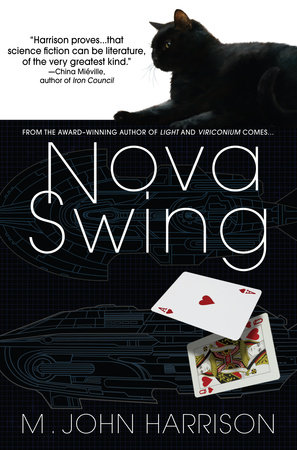
Just finised Nova Swing, book two in M. John Harrison’s Kefahuchi Tract trilogy.
Also loved the first book, Light, winner of the 2002 James Tiptree Award. It feels so nice to lose yourself in a good novel. Doesn’t happen enough these days.
No spoilers. I’m not going to review it so much as talk about what it made me think about. I like books that make me think.
The series revolves around a naked singularity called the Kefahuchi Tract, a black hole without an event horizon, around which incompatible and impossible physical laws are possible.
Nova Swing takes place on a planet where part of the Kefahuchi Tract landed, creating “the event site,” a mysterious no man’s land that both terrifies and fascinates, though people have becoming comfortable living next to it. There is an underground industry of lawbreakers who conduct tours and hunt for treasure.
All forbidden activities, due to the risk of invasion by “daughters,” entities that can turn people into alien goo. Creepy scenario, yet seemingly taken in stride by the society in the story. With the exception of law enforcement, determined to keep things from getting out of the event site.
It got me thinking, this is a trope in science fiction isn’t it? “Forbidden zones.” Places that don’t follow the rules. Places that threaten your sanity. Places that threaten to invade the outside world and make it incomprehensible. Places some are still driven to enter. Places that swallow people.
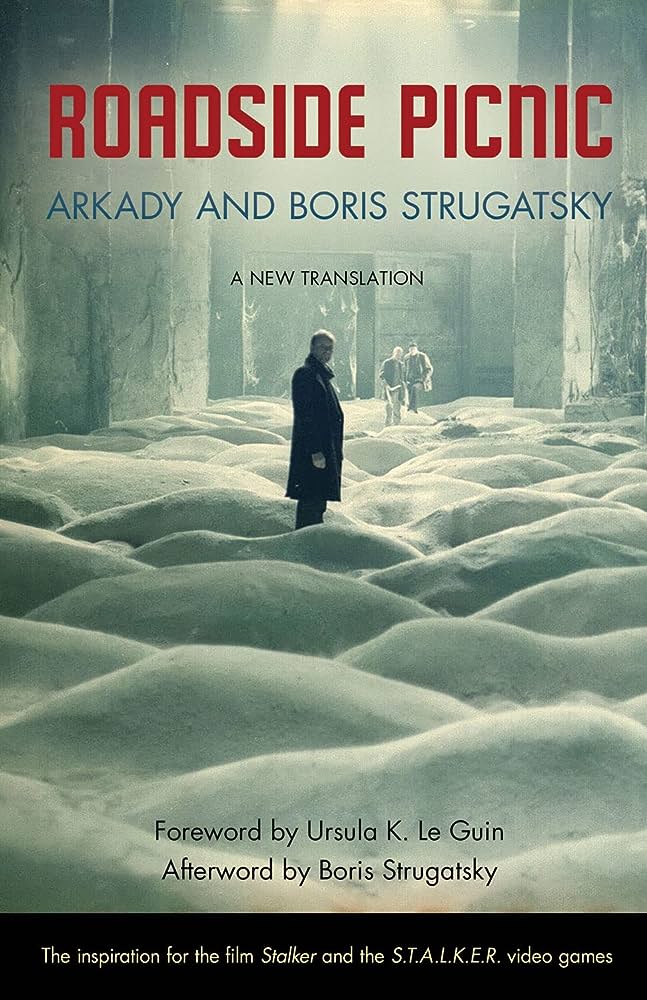
This one reminds me a lot of the Zone in Roadside Picnic by Arkady Strugatsky and Boris Strugatsky, a forbidden area exhibiting strange properties, where “stalkers” hunt for extraterrestrial artifacts they can sell.
In that book the theme seems to be that some things are just beyond understanding.
Moderat – The Mark (from the Annihilation soundtrack). Would you look into that thing? I think I would.
Vandermeer’s Annihilation is another one. A place that distorts nature, causes cancer and insanity, turns people against one another, and takes away their identities. And still people can’t resist. The drive to solve the mystery is too strong.
I think tropes are important. They tell you something about the writer’s thoughts, as well as those of the readers (or watchers if you only consume cinematic sci fi). If I see it enough, I start to suspect it’s about all of society. John Vervaeke has a theory about that regarding zombies in Western culture.
To me, those forbidden zones represent the unconscious. More specifically, how Western culture views the unconscious. As irrational, fantastical, mystical bullshit. It’s where nightmares happen, voices that tell people to kill, perverted impulses. You don’t want to go poking around in there.
What if you found out you were evil even though you didn’t wanna be? What you’re like a werewolf, a man who becomes a monster against his will? Better to leave that stuff alone, try to be disciplined, stick to the tried and true, be logical, rational, science-minded, modern.
On the other hand, it’s also where inspiration happens, isn’t it? Something from the unconscious has decided to visit you. Everyone dreams of coming up with that one idea that could change everything, make you rich. Assuming you had that idea, would it be good or evil?
I don’t think it applies. Depends on what people do with it. I think we’ll generally be OK “if enough people will do their inner work,” like Carl Jung said.
The thing about ideas that could change the world… People don’t like change. It’s why society generally punishes creative people with original ideas. Some earn respect in their lifetime, but the really good ones tend to be ahead of their time. Most of the time it’s either bully, exploit or ignore.
There’s a line in Nova Swing that speaks to that. “All crimes are crimes against continuity—continuity of life, continuity of ownership, systems continuity.”
I wonder if the message I’m getting from Devo’s song “Freedom of Choice” is the one they intended? They were prescient in a lot of ways – the whole concept of devolution seems to be panning out doesn’t it? So maybe…
I wonder if the paradox of choice occurred to them? The fact that once you get more than a certain number of choices, you actually have no choice at all. “Freedom of Choice is what you got. Freedom from choice is what you want.”
I always took that as a criticism of complacent Americans. Why do we let the powerful run over us the way we do? But that line, about the dog with two bones, “He’d lick the one, he’d lick the other. He went in circles, he dropped dead…”
I think it’s just a normal reaction to choice. What if the dog had to choose the best bone out of a trillion? That’s what we’re dealing with now. I’ve heard John Vervaeke use the term “combinatorially explosive” to describe the blast of sensory input human consciousness has to navigate.
A big part of what we do on a daily basis is ignore as much as we can and choose what we must, because otherwise we’d be unable to function. And still it’s too much for our brains.
Ideally you open your mind wide enough so you can choose the best option, but if the input continues to increase, at some point you get overwhelmed.
Things were complex enough in 1980 when that song came out. I always considered Devo to be when the modern age began. Now we have the Internet. I was blown away by all the choices at first. I discovered so much music, so many points of view I hadn’t considered.
But now I can see where it was all headed: Too. Many. Choices. Internet, it’s enough to melt your brain. You only have so much time and energy. So what do you do? Choose someone, or a collection of someones, to make choices for you.
You can still find enough variety in that narrow band of choices that it can feel like you’re getting the whole picture. Or as much of it as you need. But people you trust to make up your mind for you are in the same situation. So what are you likely to get? Choices that benefit them.
Too bad this movie came out during the Pandemic. More people should’ve seen it. I discovered it at just the right time for me.
I was walking in a little park with my wife not long after the Great Texas Freeze of 2021. Just a well-kept park with grass and a few trees. The city was recovering and the weather was nice again. The sun was setting and it was glorious.
Suddenly I felt like I was in the movie Coco. Everything felt very Mexican, then very Aztec. There were hidden symbols everywhere. I was a white guy in a quiet neighborhood – and an Indian from Mexico on a sacred quest.
The shrooms were kicking in. Time to head home.
The ghost of some graffiti the city had power-washed off the sidewalk popped out in 3-D. It reminded me of a goat, with a fish tail, like a mermaid. It meant something, I couldn’t figure out what.
About halfway home, a couple approached on the sidewalk, which made me nervous. Covid and the street violence on TV made me leery of people. They were Indians from India, out for a walk.
When we passed they smiled and I thought, good, they’re from a friendly tribe.
As we crossed a bridge, the sky darkened and so did my mood. I noticed how polluted and full of trash the creek was and I thought, “Blasphemy. How can we do that to our Mother?” I felt sick.
Then I wept because I wasn’t an Indian at all, or really anything. I was a white man from the country, living in a city full of concrete and asphalt. I didn’t have a tribe. I liked the culture of the city, but I didn’t belong. I missed the trees. I missed the wildlife. My wife grew up in the city and didn’t understand.
And I thought, how was that not a tribe? If you look at it that way, I’ve belonged to several over the years – rural, suburbanite, city dweller, conservative, liberal, progressive. Or anyway I tried to belong.
I hated seeing all the tribes of America at each other’s throats – when as Americans, especially white Americans, we’re all faced with the same difficult question: Who the hell are we?
I had just watched News of the World, the Tom Hanks movie about Texas during Reconstruction. Captain Kidd, Tom Hanks’ character, earns a living riding treacherous roads from town to town, reading newspaper articles to war weary citizens.
Kidd agrees to take on a twice orphaned German girl. Her parents were killed by Kiowa, who adopted her. They were then killed by Union soldiers who were busy running the Native Americans off their land. He takes her to her German relatives, but it doesn’t work out. She’s not one of them anymore.
There’s a scene where the girl wails at the Kiowa to come back as they ride across the Red River on their way to Oklahoma. But they can’t. The river is flooding. That part of her life was over forever. I felt that little girl’s pain. She had lost her connection to the earth. She’d become like us.
Those of us who come from settlers-on-other-peoples’-land have a little bit of that suffering in our hearts, whether we admit it or not. Not just because of guilt over the things our ancestors did, over slavery, over the Indians, but because of loss.
The continent modernized and towns became cities. Folks left their farms and got work in factories. They fought in modern wars. They became modern people, and they lost the earth.
The process continues as the cities devour our little towns, as the stores shutter and the populations plummet. Cities are important, the engines of our civilization. We need their culture. They’re a sanctuary for some of us. But if you ever lived outside a city you know: cities eat towns.
Leaving a town for the city wasn’t the leap that it was for settlers who left the frontier. We had running water and electricity after all. A lot of us went to college. But we lost the places where it felt like we mattered. And we’re that much further from the earth.
Some of us try to compromise, move to the suburbs, buy big trucks, listen to country music and pretend it’s about us, but we know deep down it isn’t, or the trucks wouldn’t be so big. The country is not our world anymore.
The machine ate us.
It wasn’t the mushroom trip I would have chosen. I wouldn’t call it fun. My wife certainly didn’t. But it was exactly what I needed.
Somehow remembering the Tom Hanks movie made me feel better. Captain Kidd was the Mister Rogers of the West, I thought. He couldn’t fix the world’s pain or his own, but reading those stories reminded people about life, about being human. It helped.
Not to be naive. Humans can be evil. Some of us have been leaning into it, but it’s good to be reminded of the other side of humanity: the humor, the art and the music, the way we push on when things get rough. You can always find the humanity if you look for it.
Tyrone Davis – If I Could Turn Back the Hands of Time
When I screwed up in the newspaper business, I ran corrections. I hated putting out wrong information, stories with typos or missing jumps. You might see them, you might not. But I tried.
The Internet has changed the whole concept of corrections. I’ve already made a few mistakes on this blog that I went back and fixed. I try to get to it before anyone catches it, but I always wonder. How many people saw both versions and are questioning their memories right now?
The Mandela Effect is such an interesting conspiracy theory. People claim to remember Mandela dying in prison instead of going on to become president of South Africa. Evidence for Doctor Who? If a time traveler tweaked the past what would happen to our memories? If you remembered something from another timeline, how could you ever prove it?
Memory is pretty fallible. I remember things wrong sometimes, who was there, who said what. But I don’t remember people attributing that to time travel until relatively recently.
It occurs to me the popularity of that idea – other than the fact it’s a fun theory – might have to do with the character of the Internet. Articles and social media comments disappear, giving people the opportunity to say “I never said that.”
Even on Wikipedia, which has a pretty good reputation for backing up its content, links to websites that no longer exist. Did that article exist and can you prove it? AI complicates things even further. I understand ChatGPT has been caught citing articles that never existed.
Kinda creepy isn’t it? Did I really see the thing or is it a figment of my imagination? Makes me wonder what that’s doing to society, that already disagrees over so many things.
Call me old fashioned, but I do believe reality has a ground floor and truth exists. Figuring out what those things are is another matter. It’s hard enough to do as it is. I’m afraid it’s going to get harder.
Foxy – Get Off. I got such a kick out of this video. I remember thinking this song was cool, back when I only heard music on Top 40 AM radio. Not sure what I would’ve thought if I had seen this as a teenager.
Seeing this over the top video of Get Off, by Foxy really took me back. I thought the song was cool when I heard it on the radio. What teenager wouldn’t? It’s about sex. But I definitely imagined them looking so much cooler.
I liked disco as a kid – until I didn’t. It was just one kind of pop music, like R&B or rock. Not that I thought of music in terms of genre back then. You just listened to the Top 40 station (KTSA) and you either liked it or you didn’t.
This is a little playlist I threw together of disco hits I remember liking. There were a lot more.The songs actually sound pretty good to me now.
I was a freshman in high school when I saw a long-haired rock ‘n’ roll dude in a “Disco Sucks” T-shirt. I remember thinking “Somebody had to say it.” I didn’t hate disco exactly. I just realized I was really really tired of it. The fact that I’d just discovered album rock played a big part also.
I didn’t yet know about the “Disco Demolition” incident in Chicago where they blew a bunch of disco records at a Chicago White Sox game and caused a riot. But I wouldn’t have been surprised.
I understand a lot of people put the anti-disco backlash down to racism and homophobia. That was probably part of it. My friend’s dad had some choice nicknames for disco. I’m sure there was a lot of heartburn over the Village People getting as popular as they were.
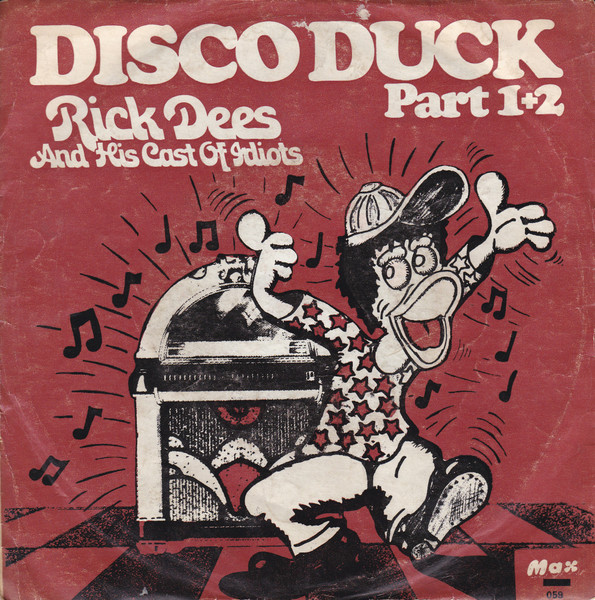
I liked Disco Duck by DJ Rick Dees – when I was 12.I don’t really want to hear it again.
But mainly I think it was over-saturation. The market did what the market does: took something popular, tried to squeeze out every penny, and ran it into the ground. It was in movies, TV, advertisement jingles. There had to be a disco version of everything, from classical music to jazz.
And you couldn’t escape the Bee Gees, who frankly were too good for their own good. If they weren’t on the radio or TV, they were producing somebody else’s song and singing backup. After a while enough was enough.
It’s been long enough now that I can listen to disco again and enjoy it. Even the Bee Gees. I also like that younger generations don’t have those prejudices against different types of music. Disco is as legit as anything else.
 Late Boomer's Den
You must be logged in to post a comment.