Divided cities are an interesting phenomenon. You have cities that grow and merge, and cities that split apart, usually because of politics. They differ in their level of connectedness.
For a while we had East and West Berlin, with a wall in between. Until the 1870s Budapest, Hungary was Buda and Pest, with the Danube River in between.
In America, we have a lot of “twin” cities. In Texas we have the Dallas-Fort Worth Metroplex and Midland-Odessa.
Usually one of the cities in a “twin” relationship is more working class than the other, but when you come down to it, they’re still American. American culture, American social norms.
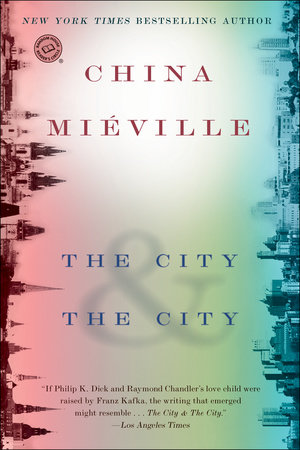
In The City and the City, China Miéville writes about fictitious cities Besz and Ul Qoma. The cities are physically adjacent – they have many “cross-hatched” regions – but their societies are kept strictly separated. This, despite the fact that they share streets, highways and railways,
By mutual agreement of Besz and Ul Qoma, a mysterious entity called Breach keeps citizens from mingling and interacting, on pain of arrest or worse. And you never know if Breach is watching.
The City and the City is a murder mystery that develops into an interesting study of society and law. A body is found in a crosshatched area. Did the crime occur in Besz or Ul Qoma and did anybody “breach”?
And could there be a mysterious third city flying under the radar?
Citizens of both cities have to be trained from childhood to purposely ignore any person or thing not of their city. Citizens learn to “unsee” (and even unsmell!) anything that doesn’t belong in their city. There are unificationist groups in both cities, but they are treated as radicals and suppressed.
It’s crazy when you think about it, how much the concept of a border depends on belief. There may be a fence or a wall or a line on a map, but the earth doesn’t care. It’s people who make borders happen.
I enjoyed the murder mystery and protagonist Tyador’s detective work, but the conceptual stuff was especially interesting. Enforcing a border via psychology.
Unseeing. Pretending you didn’t see to the point that for practical purposes you didn’t. Is that really possible?
It got me thinking of anti-memes – objects, creatures and phenomena that use forgettability as camouflage. qntm’s novel There Is No Antimemetics Division, takes that concept to ridiculous and extremes, but “anti-memetic” does seem to be a thing. Can you describe the last panhandler you saw while driving? Probably not. I can’t.
I actually forgot an entire city. I was talking about twin cities and totally forgot that El Paso, where I live is exactly such a city, or half-city. The Rio Grande officially separates El Paso from Juarez, as well as U.S. from Mexico. But the real separation is cultural.
Borders are imaginary until you make them solid, but still in the most important ways, they’re imaginary. Before it was part of the U.S., Texas has been territory of Spain, France, Mexico, itself, the Confederacy and the territory of various native American peoples.
Who will claim it in 1,000 years? It won’t be more than a claim. The earth doesn’t care about lines on maps.
 Late Boomer's Den